SEO as a Long-Term Growth Strategy for Global Businesses
Belk Digital Editorial TeamJuly 30, 202613 read
Wondering if SEO is worth the wait? Belk Digital breaks down the real, sourced case for SEO as a compounding business investment, structural comparisons with paid advertising, multi-market sequencing, and AI search adaptation.
Introduction
Six months into an SEO engagement, someone in a budget meeting always asks the same question: is this actually working? It's a fair question, and SEO's own advocates don't always answer it well — "be patient" isn't a business case. This guide is that business case, built on the one structural fact that actually holds up under scrutiny: paid traffic is rented, and organic traffic is owned. The moment you stop paying for ads, that traffic stops. The moment you stop actively working on SEO, existing rankings don't vanish overnight — they decay slowly, and what you've built keeps working for you in the meantime.
This guide covers the real, honestly-sourced comparison between SEO and paid advertising over time, how organic authority compounds rather than resets, what a long-term strategy looks like for a business operating in multiple markets, how to actually measure whether it's working, and how GEO and AEO fit in as the next layer rather than something separate.
Key Takeaways: SEO as a Compounding Business Asset
A sustainable search strategy transforms marketing from a recurring operating expense into an enterprise asset:
SEO and paid advertising aren't competing tactics — they're different kinds of assets. Paid traffic disappears the moment ad spend stops; organic rankings decay gradually and continue generating revenue from past investment.
Many widely circulated "SEO ROI" percentage claims trace back to marketing hype rather than rigorous studies — the safest business case uses your own conversion and traffic data, not a borrowed industry benchmark.
SEO results take months to build, but the investment compounds: content and topical authority built in year one continue generating customer acquisition in year three and beyond.
Global and multi-market enterprises need a structured, sequenced SEO approach — trying to build authority in every country simultaneously usually leads to zero traction anywhere.
GEO and AEO are not a reason to abandon SEO fundamentals — they're an extension of them. Businesses with strong technical and topical foundations adapt to AI search engines fastest.
SEO vs. Paid Advertising: The Honest Long-Term Comparison
Quick Answer: Is SEO Really Better Than Paid Ads Long-Term?
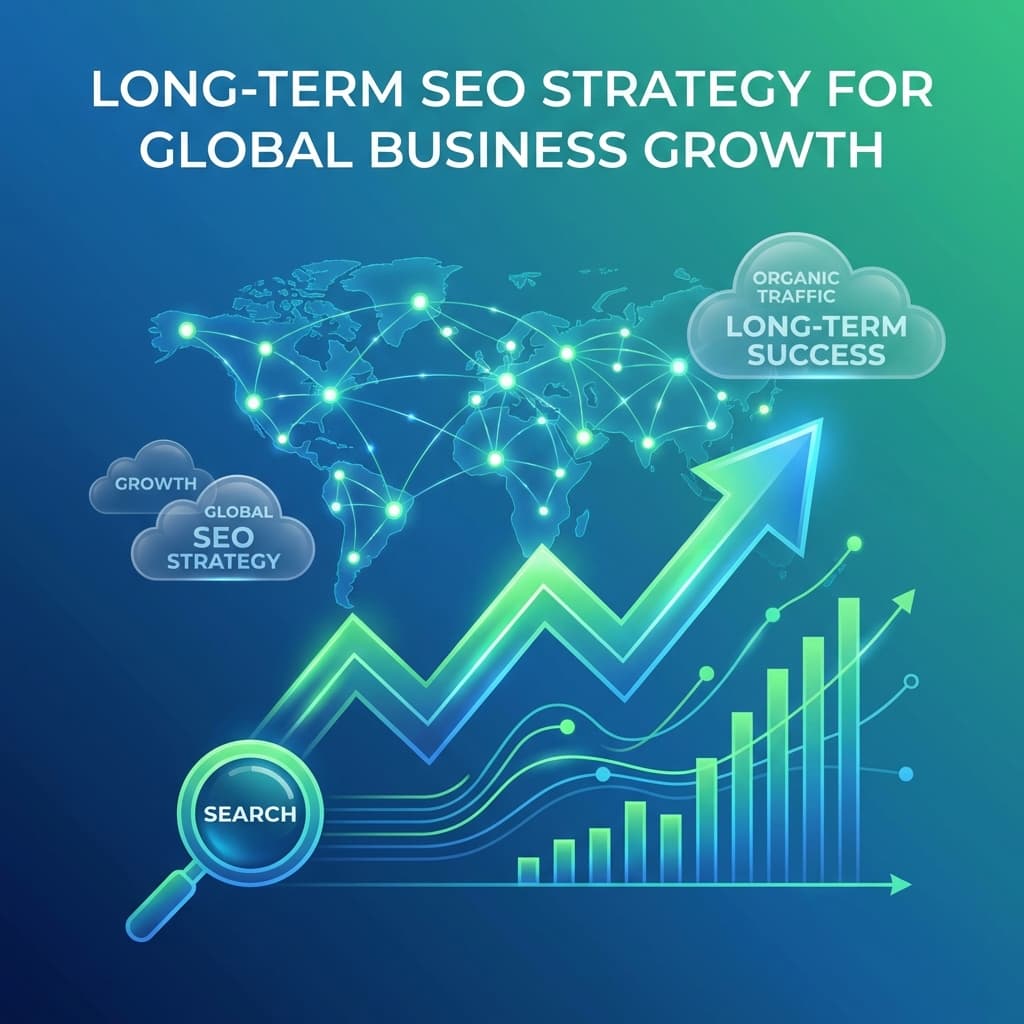
SEO and paid advertising serve complementary functions rather than one strictly eliminating the other. Paid advertising delivers immediate, controllable demand capture that ceases the second budgets pause. SEO requires several months to build momentum but creates a durable asset — content clusters and domain authority — that captures market share without a recurring per-click tax.
Structural Channel Comparison:
• What You Are Building: Paid advertising rents audience attention; SEO builds owned domain equity that appreciates over time.
• Timeline to Results: PPC produces instant ad impressions; SEO builds compounding organic momentum over quarters.
• Budget Interruption Impact: Paid traffic drops to zero instantly; organic rankings decay slowly, sustaining lead generation.
Cost Trajectory Over Time: In paid advertising, cost-per-click (CPC) tends to increase as auction competition intensifies; in organic search, marginal cost per visitor falls as domain authority compounds.
Competitive Defensibility: Competitors can instantly outbid your PPC ads with higher budgets, but duplicating established topical authority and backlink equity takes years of sustained effort.
Search Intent Capture: Organic search listings consistently capture over 70% of total search clicks, establishing trust that paid banner ads cannot replicate.
How SEO Compounds: Topical and Brand Authority Over Time
The mechanism behind organic search equity is domain trust. Search engines (and modern LLM retrieval systems) develop confidence in a website through consistent patterns of high-quality, interconnected, and authoritative content.
Evergreen Content Yield: Individual pillar guides continue generating qualified inbound leads years after publication, unlike paid campaigns that end with budget cycles.
Topical Cluster Synergy: A connected web of supporting articles around core pillars earns exponentially higher collective authority than disconnected, standalone blog posts.
Accelerated Indexing: New pages published on an established, high-authority domain index faster and rank sooner than identical content on a fresh, untrusted domain.
Structuring Long-Term SEO for Global and Multi-Market Businesses
International enterprises often stumble by attempting simultaneous rollouts across a dozen countries, spreading budget and editorial resources too thin. For comprehensive technical execution (URL routing, hreflang, and canonicals), refer to our international SEO guide. Strategic sequencing requires:
Market Opportunity Prioritization: Evaluate expansion territories by commercial intent and localized competition rather than raw GDP — mid-sized markets often deliver faster ROI than saturated tier-one regions.
Focused Authority Building: Establish dominant market authority in one or two regional hubs before expanding across broader language territories.
Topical Framework Reuse: Localize proven content architectures and core service hubs rather than reinventing the digital strategy in every new jurisdiction.
Localized Trust Expectations: Recognize that while domain authority provides a baseline lift, market-specific trust signals, ccTLD routing, and native backlinks must be cultivated locally.
Adapting Long-Term SEO Strategy for the AI Search Era (GEO & AEO)
A future-proof search strategy must incorporate Generative Engine Optimization (GEO) and Answer Engine Optimization (AEO). For deep technical breakdowns, read our Generative Engine Optimization guide and our AI Search and SEO 2026 guide.
The Practical Implication:
Do not treat AI search readiness as an isolated budget line competing with SEO investment. AI search engines (Perplexity, ChatGPT Search, Google AI Overviews) rely on the exact signals that classic technical SEO builds: structured semantic schema, factual consistency, concise direct answers, and verified authoritativeness. The brands winning AI citations today are overwhelmingly those that built strong organic search foundations first.
Schema & Structured Entities: Implement JSON-LD schemas to make your core value propositions unambiguously machine-readable for AI crawlers.
Direct Answer Architecture: Structure headers and executive summaries to answer complex commercial queries directly within the first 150 words.
Entity Authority: Maintain uniform brand citations, author credentials, and verified external references across digital channels.
Choosing an Agency or Building In-House: Decision Framework
Whether managing SEO internally or selecting an external growth partner, evaluate capabilities against this enterprise checklist:
Transparent Timelines: Do they set realistic 6–12 month compounding horizons, or promise unrealistic quick fixes that trigger algorithmic penalties?
Empirical Business Cases: Do they substantiate strategy with client-specific financial metrics rather than unsubstantiated industry ROI claims?
Native AI Integration: Do they treat GEO and AEO as direct extensions of technical SEO rather than an unrelated upsell?
Multi-Market Track Record: Do they demonstrate proven experience managing multi-region technical architectures, hreflang clusters, and localized search campaigns?
Conclusion
SEO is not a tactical expense — it is an appreciating enterprise asset that builds commercial authority, drives high-intent customer acquisition, and protects digital market share. By pairing technical excellence with topical compounding, businesses establish enduring organic pipelines that outperform rented ad channels year after year. To build your search roadmap, explore our long-term SEO strategy services, review our client case studies, view our portfolio, or request an SEO strategy consultation with Belk Digital.