How to Optimize Your Website for AI Search: A Practical GEO/AEO Implementation Guide
A technical, evidence-based guide to making your website accessible, understandable, and referenceable for Google AI Overviews, ChatGPT Search, and Perplexity.
Introducción
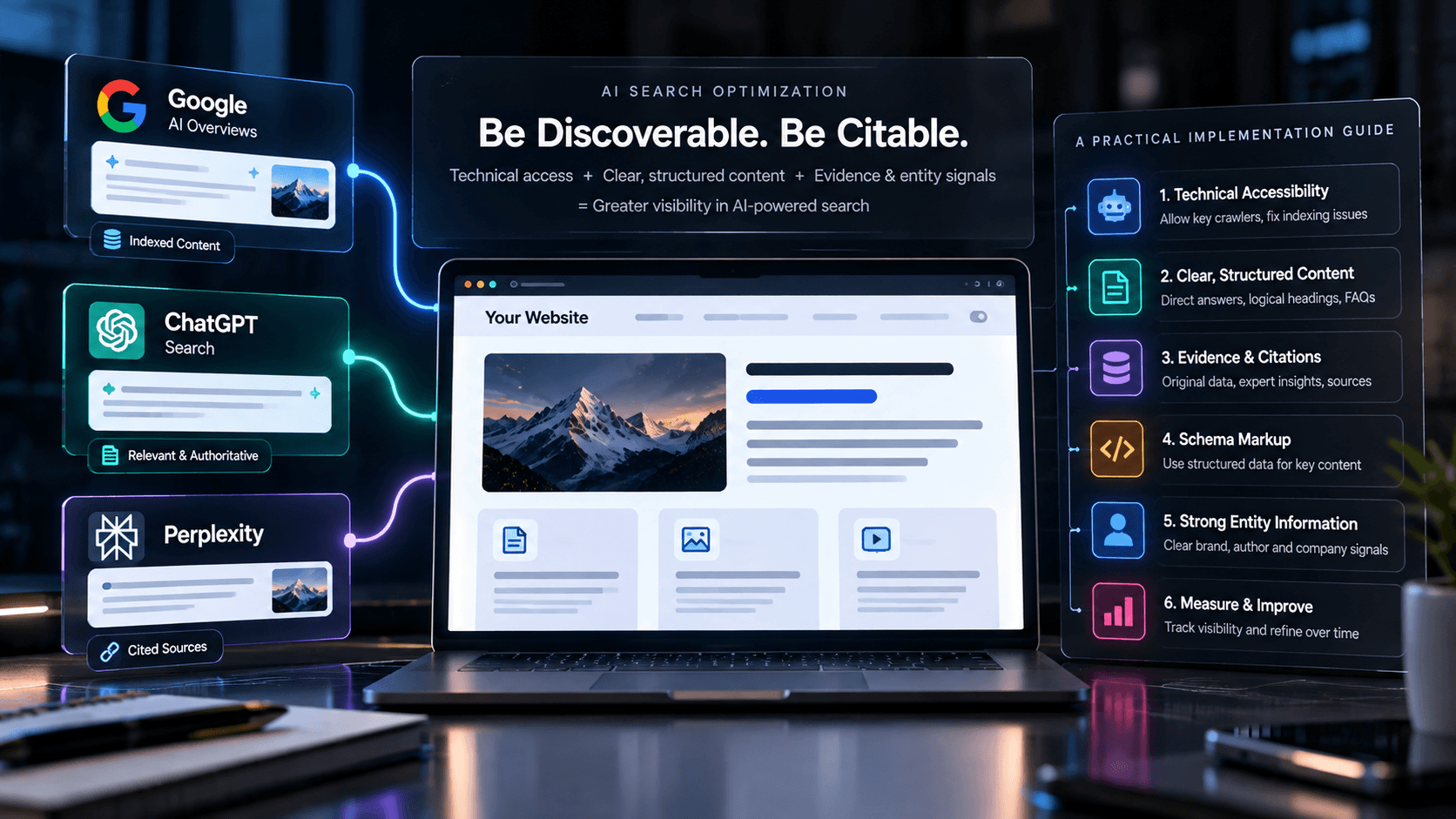
When search platforms provide direct, AI-generated answers, keeping a website discoverable requires more than ranking on a traditional results page. Platforms like Google AI Overviews, ChatGPT Search, and Perplexity synthesize answers directly from multiple sources, choosing which websites to cite as evidence and which to omit. For website owners and SEO teams, the central problem is practical: how do you ensure your content is discoverable, understandable, and trusted enough to be referenced when users get an immediate answer instead of clicking through traditional listings? AI search optimization (encompassing Generative Engine Optimization, or GEO, and Answer Engine Optimization, or AEO) addresses this challenge. It pairs reliable technical access—making sure crawlers can reach and interpret your pages—with clear, evidence-backed information that automated systems can evaluate and attribute.
What AI search optimization actually means
Much of the discussion around AI search treats SEO, AEO, and GEO as competing disciplines. In practice, they are different lenses on the same objective: making content discoverable, understandable, and useful.
- SEO (Search Engine Optimization) ensures your site is discoverable and competitive within traditional search indexation and ranking algorithms.
- AEO (Answer Engine Optimization) formats specific answers so search engines and virtual assistants can extract standalone snippets for voice search and featured answer boxes.
- GEO (Generative Engine Optimization) focuses on the broader context required by language models that synthesize multi-source responses rather than pointing users to a single destination link.
If your website already has sound technical SEO, a clear heading structure, and substantive content, you have already built the core foundation for GEO. What changes is how generative systems evaluate and extract your information.
Earning an AI citation is fundamentally different from ranking in position one. An AI engine might cite a page ranking sixth because it contains a clear definition or verifiable dataset, bypass a top-ranking page whose copy is vague or promotional, or generate an answer without naming any source at all. Because these systems evaluate relevance and credibility dynamically, shortcuts like keyword stuffing or artificial sentence templates do not work. Enduring visibility requires technical accessibility and authoritative information, as explored in Belk Digital's GEO enterprise guide.
How Google AI Overviews, ChatGPT Search, and Perplexity discover content
Optimizing for AI search starts with recognizing that different platforms discover and process web content in very different ways. Treating "AI search" as a single engine leads to misallocated effort.
Google: Standard Indexing Powers AI Overviews
As outlined in Google's official AI features documentation, there is no dedicated AI crawler or separate opt-in form for Google AI Overviews. Google draws directly from its standard search index populated by Googlebot. If a page is crawled, indexed, and compliant with Google Search Essentials, it is eligible to appear as a supporting reference in AI Overviews and AI Mode.
Webmasters who want to manage how their content appears can use standard robots meta tags, such as `nosnippet`, `max-snippet`, or the `data-nosnippet` attribute for specific page elements. Meeting Google's search requirements makes a page eligible to appear, but does not guarantee inclusion in AI Overviews or AI Mode.
ChatGPT Search: Separate Crawlers for Search and Model Training
OpenAI divides its crawling activities across distinct user agents with specific responsibilities, detailed in OpenAI's crawler documentation and ChatGPT Search guidance:
- OAI-SearchBot: Crawls the web specifically to index content and display links within ChatGPT Search. It does not train foundation models. Allowing OAI-SearchBot in your `robots.txt` and ensuring your firewall permits OpenAI's published search bot IP ranges makes your site eligible for ChatGPT search citations.
- GPTBot: Scrapes web data to train OpenAI's future foundation models. You can disallow GPTBot in `robots.txt` if you prefer not to contribute to model training, and doing so will not prevent your site from appearing in ChatGPT Search.
- ChatGPT-User: Executes on-demand page fetches when a user explicitly submits a prompt that requires live web browsing or asks ChatGPT to examine a specific URL.
Perplexity: Real-Time Search and robots.txt Compliance
Perplexity relies on two main crawlers, documented in Perplexity's crawler documentation and Perplexity's robots.txt guidance:
- PerplexityBot: A web crawler that discovers and indexes pages to support search queries and citation generation. Perplexity notes that it does not use crawler data to train foundation models.
- Perplexity-User: Performs live fetches in response to user questions during real-time browsing sessions.
Perplexity confirms that PerplexityBot honors standard `robots.txt` disallow rules. If you block PerplexityBot, the crawler will not scrape your page content. However, like other search systems, Perplexity may still mention a domain or display a factual reference if that information is corroborated by third-party indexed sources.
Access Opens the Door, but Content Earns the Citation
Across all three platforms, crawler access is a necessary starting point. Without it, your pages cannot be evaluated. But access alone never guarantees that an AI model will cite your page for any given query. The model's decision depends on contextual relevance, clarity, and perceived authority at the moment of synthesis.
Step 1 — Diagnose whether AI systems can access your website
Before spending time rewriting copy, verify that search engines and AI agents can physically fetch and render your pages. Many visibility issues trace back to simple infrastructure barriers.
Check Indexing and Crawling Status in Google Search Console
Start with the Page Indexing report in Google Search Console, distinguishing crawl access from indexing:
- Disallowed by robots.txt: A robots.txt rule controls crawling and does not, by itself, prevent indexing. It stops Googlebot from visiting a page, but Google can still index the URL if other pages link to it. Because Google cannot crawl the page to read its content or discover a `noindex` directive, it cannot evaluate or cite that text in AI Overviews.
- Excluded by 'noindex' tag: A `noindex` directive prevents a page from appearing in search results. Crucially, Google must be able to crawl the page to read the `noindex` tag; if a URL is blocked in robots.txt, Google never sees the directive. Verify that staging headers (such as `X-Robots-Tag: noindex`) were not left in production on pages meant to be indexed.
- Crawled - currently not indexed: Google crawled the page but has not added it to the index. A URL that is not indexed generally cannot appear as a normal search result or support an AI Overview, though its indexing status can change as Google re-evaluates page quality and internal link signals over time.
- Canonical tags: Confirm target URLs specify their own canonical URL rather than pointing search engines to an unintended page.
Check robots.txt Permissions
Inspect your live `robots.txt` file at `yourdomain.com/robots.txt`. Review directives for `Googlebot`, `OAI-SearchBot`, `PerplexityBot`, and `ChatGPT-User`. Ensure that broad disallow rules aimed at internal scripts or admin paths do not accidentally catch informational pages, product guides, or resource libraries.
Inspect WAF and Firewall Rules
Web Application Firewalls (such as Cloudflare, AWS WAF, or Fastly) and rate-limiting rules frequently flag automated crawlers as suspicious traffic. Review firewall logs for 403 Forbidden or 429 Too Many Requests responses served to verified crawler user agents. Ensure that verified crawler IP ranges are allowlisted in your security policies.
Verify Server-Side Rendering
AI crawlers operate on tight resource budgets. If your website relies entirely on client-side JavaScript to render headings, body paragraphs, and data tables, some crawlers may index an empty shell or fail to execute the scripts required to reveal your content. Use Google's URL Inspection Tool or fetch raw page source via curl to confirm that your primary content is present in the initial server-delivered HTML.
Step 2 — Make pages easy to interpret
Once technical access is confirmed, focus on how information is structured. Generative models break text down into semantic chunks to find direct answers and extract facts. If your content is ambiguous, buried, or contradictory, the model will simply move to an easier source.
State Key Answers Directly
When an article addresses a specific question, provide a clear, direct answer early in that section. Avoid withholding the answer until the end of the page as suspense. State the core finding or recommendation upfront, then follow with the supporting rationale, technical details, and real-world nuance. Focus on answering the question completely and concisely.
Use Clear, Descriptive Headings
Structure your pages with a logical hierarchy of H2 and H3 headings that reflect real questions readers ask. Descriptive headings help both human readers skimming a page and automated parsers evaluating which section addresses a specific subtopic.
Support Material Claims with Verifiable Evidence
Back important assertions with concrete data, original analysis, or primary documentation. Language models are increasingly designed to identify verifiable facts and trace claims to credible origins. When you introduce statistics or technical standards, link directly to the primary source rather than quoting secondary commentary.
Maintain Consistency Across Your Website
Audit related articles across your domain to ensure that product specifications, pricing, dates, and core business facts align. Internal contradictions confuse automated extraction engines and weaken your site's overall topical authority.
Focus on Helpful Depth Over Formulaic Writing
Resist the temptation to force rigid paragraph quotas or split natural explanations into awkward, disconnected fragments. Google explicitly advises against writing exclusively for search bots. Focus on writing thorough, logical explanations that satisfy a knowledgeable human reader.
Step 3 — Strengthen entities, authorship, and trust
Search engines evaluate content within the context of the entity that published it and the author who wrote it. In AI search, establishing clear real-world trust signals helps models weigh the credibility of your claims.
Maintain Clear Organization Information
Ensure your organization's official name, leadership, contact avenues, and primary services are accurately represented across your website and external business profiles (such as LinkedIn, Crunchbase, or relevant industry associations). Note that digital consultancies, software platforms, and service-area businesses do not all require physical storefront addresses or Google Business Profiles. For these companies, entity credibility is reinforced through transparent corporate registration, consistent `Organization` structured data, and verifiable industry associations.
Provide Transparent Author Attribution
Include clear author bylines accompanied by concise biographies that highlight relevant professional experience and subject-matter knowledge. Demonstrating that technical content was written or reviewed by experienced practitioners builds confidence for human readers and aligns with search quality standards.
Be Clear About Scope and Limitations
Credible technical writing openly discusses trade-offs, prerequisites, and edge cases. When you explain a strategy or tool, outline when it makes sense and when it does not. Honest, balanced analysis distinguishes authoritative content from generic marketing copy.
Step 4 — Use structured data appropriately
Structured data provides explicit semantic clues about the people, products, and ideas on a page. While structured data does not guarantee AI citations, it helps machines interpret your content accurately.
Implement Standard, Accurate Schemas
Use established Schema.org vocabularies—such as `Article`, `Organization`, and `BreadcrumbList`—to describe page elements accurately. Keep your markup aligned with the visible text on the page; discrepancies between structured data and user-facing content can trigger spam penalties.
Take a Balanced Approach to FAQ Schema
Google has significantly restricted `FAQPage` rich results in search results, focusing primarily on authoritative government and healthcare resources. Implement FAQ schema when you have genuine, well-structured questions and answers that help parsers interpret complex topics, but do not expect rich snippet badges or automatic AI citations simply because the markup is present.
Validate All Markup
Test your JSON-LD implementation using the Schema Markup Validator and Google's Rich Results Test. Fix missing required properties, syntax errors, and malformed tags to ensure your structured data is readable.
Step 5 — Measure what is actually available
Measuring AI search performance requires a pragmatic approach. Because generative engines personalize responses and change rapidly, traditional rank tracking metrics tell only part of the story.
Monitor Trends in Google Search Console
Google Search Console remains your most reliable source of search data. Track organic impressions, clicks, and average ranking positions for your key query themes. While Search Console does not currently provide a dedicated filter for AI Overview appearances, shifts in impressions and click-through rates across informational queries provide valuable signals about how your pages are performing as AI search features evolve.
Track Referral Traffic in Web Analytics
Set up custom segments in your analytics platform to monitor incoming sessions from known AI domains, including `chatgpt.com`, `perplexity.ai`, and `gemini.google.com`. Keep in mind that many AI citations do not pass referrer headers, meaning some traffic will register as direct visits. Looking for correlation between citation activity and branded direct traffic can provide additional context.
Conduct Regular Manual Sampling
Establish a recurring monthly routine of testing 10 to 15 core, high-intent user prompts across Google AI Overviews, ChatGPT Search, and Perplexity. Document whether your domain is cited, which specific pages are referenced, and whether the synthesized answer represents your brand accurately.
Treat Third-Party Visibility Scores with Perspective
Emerging AI visibility and GEO tracking tools offer helpful directional insights, but no software platform has complete visibility into every dynamic, personalized AI inference. Use third-party scores as general benchmarks rather than absolute metrics, and always evaluate them alongside real search traffic and qualified business inquiries.
AI search optimization implementation checklist
Use this checklist to audit and refine your site's readiness for AI search engines:
1. Technical Accessibility
- Verify that priority pages are indexed in Google Search Console's Page Indexing report.
- Review `robots.txt` to ensure Googlebot and relevant AI search crawlers are not unintentionally blocked from accessing public content.
- Check firewall and CDN logs to confirm that legitimate AI crawler IP ranges are not receiving 403 or 429 blocks.
- Confirm that essential headings, text, and tables are delivered in server-rendered HTML rather than relying solely on client-side JavaScript.
- Check that canonical tags point to the preferred live URLs and that no unintended noindex directives remain.
2. Content Clarity and Evidence
- Lead important sections with direct, informative answers to user questions.
- Organize articles with clear, logical H2 and H3 headings that reflect user search intent.
- Support core claims with verifiable numbers, original analysis, or primary documentation.
- Link directly to primary source documentation rather than repeating secondary summaries.
- Audit published content to maintain factual consistency across your entire domain.
- Prioritize useful depth and natural writing over arbitrary formatting rules.
3. Entities and Trust
- Maintain consistent organization information across your website, structured data, and business profiles.
- Include transparent author bylines with biographies highlighting relevant experience.
- Display publication and last-updated dates on technical and operational articles.
- Clearly communicate practical prerequisites, limitations, and edge cases.
4. Structured Data
- Implement standard `Article`, `BreadcrumbList`, and `Organization` schemas where applicable.
- Use `FAQPage` schema to clarify complex topics without expecting guaranteed rich results.
- Validate all markup using the Schema Markup Validator to prevent syntax errors.
5. Ongoing Measurement
- Record baseline impression, click, and ranking trends in Google Search Console.
- Monitor referral traffic from AI platforms such as ChatGPT and Perplexity in web analytics.
- Run monthly manual prompt sampling across 10–15 representative search queries.
- Review organic performance on 30-, 60-, and 90-day cycles to evaluate long-term trends.
Conclusión
AI search visibility is built on sound technical fundamentals and substantive, trustworthy content: ensuring crawlers can access your pages easily, and providing clear, verifiable information that both human readers and answer engines can rely on. No formatting trick, keyword density formula, or word-count quota can replace accessible infrastructure and credible insight. Start by auditing crawler accessibility in Step 1, strengthen the clarity and evidence on your core pages, and ensure organizational details are accurate and consistent across the web. For a comprehensive audit of your website's search architecture and crawlability, explore Belk Digital's SEO services.
Primary Documentation & Authoritative Resources
- Google Search Central: AI Features and Search — Official guidance on Googlebot indexing, snippet eligibility, and AI Overviews.
- OpenAI: Overview of OpenAI Crawlers — Official technical specifications for OAI-SearchBot, GPTBot, and ChatGPT-User.
- OpenAI: ChatGPT Search Guidance — How ChatGPT Search discovers, indexes, and ranks web sources.
- Perplexity AI: Perplexity Crawlers Documentation — Technical details on PerplexityBot and Perplexity-User.
- Perplexity AI: How Perplexity Follows robots.txt — Official guidelines on robots.txt compliance and web citation.
Preguntas Frecuentes
¿Listo para Transformar su Presencia Digital?
Let's discuss how we can help you achieve your digital goals and create an exceptional online presence.