Meta Partnership Ads in 2026: How Brands Can Test Creator Content and Measure Results
A creator's post performing well organically doesn't mean it's ready to run as a paid ad — permission, disclosure, and usage rights all have to be settled first. Here's the actual workflow, not just the permission button.
Introduction
Most brands discover Meta Partnership Ads the same way: a creator's organic post is doing well, and someone on the marketing team asks why it isn't running as a paid ad yet. The honest answer is that "it's doing well organically" and "it's ready to run as a Partnership Ad" are two different questions, separated by a handful of steps that have nothing to do with creative quality — permission, disclosure, and usage rights, specifically.
Meta's own description of the feature is straightforward: creators can allow business partners to boost branded content into a partnership ad on Instagram and Facebook. What that one sentence doesn't cover is everything that has to happen before and after that boost — which permission type actually applies, what a brand and creator need to agree on beyond the platform's permission toggle, how the paid-partnership label relates to a brand's actual FTC disclosure obligations, and how to test a creator-led ad against a brand-led one without fooling yourself about the result.
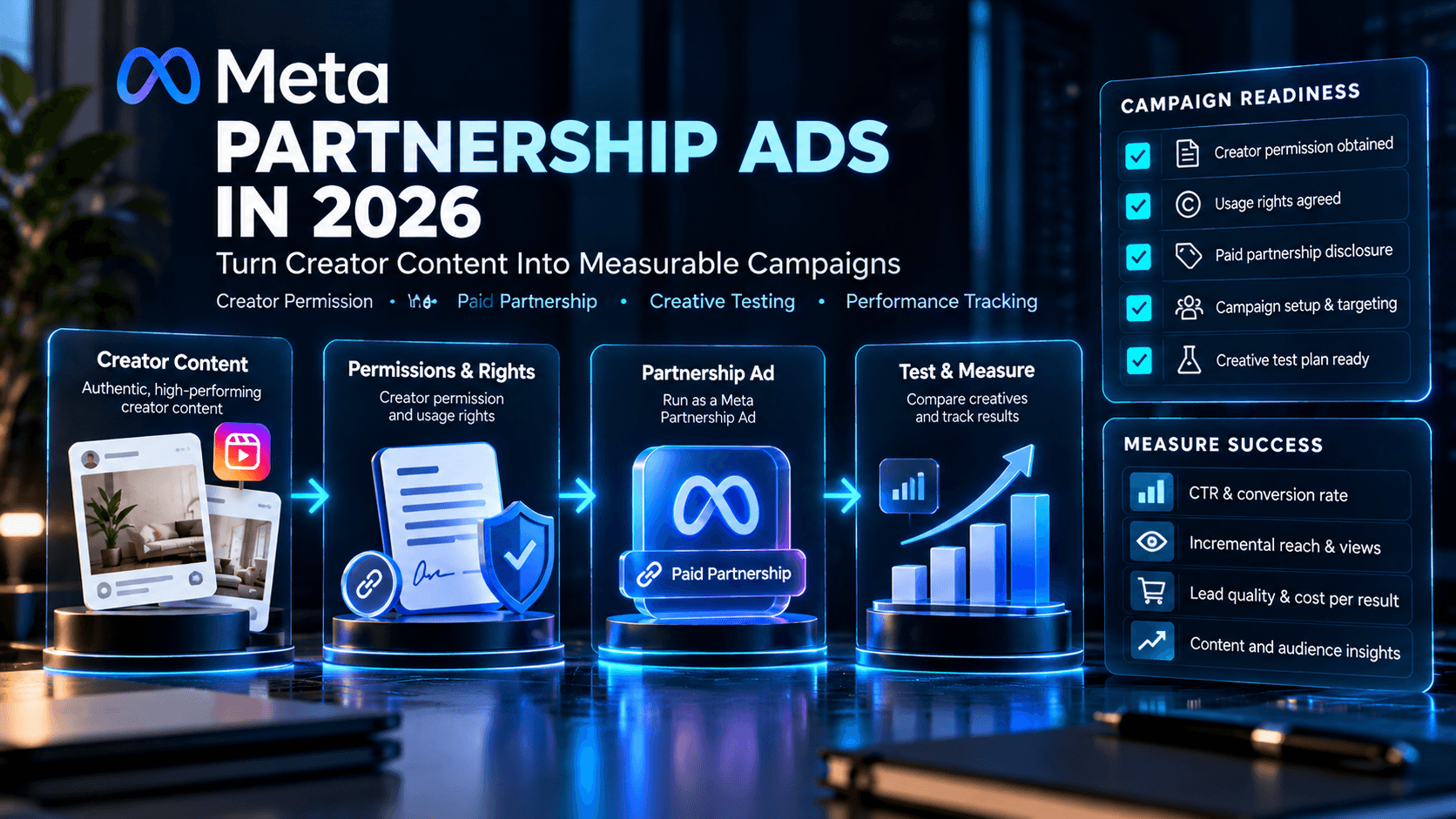
This guide walks through that full sequence: what Partnership Ads are and aren't, how the permission system actually works, what belongs in a commercial agreement that Meta's settings don't cover, how to run a fair test, and how to measure what the campaign actually did — separate from what the dashboard makes it look like it did.
What are Meta Partnership Ads?
A Partnership Ad is a paid ad that runs using a creator's branded content, with the creator's identity attached, after the creator has granted a brand permission to promote it. The ad itself can appear to show the creator's username and profile the way their organic post would, while the brand funds and manages the paid placement behind it.
That's a meaningfully different thing from a brand simply reposting or repurposing creator content into its own ad account under the brand's own name. Partnership Ads preserve the creator's presence in the ad, which is part of why the format tends to read as more native than a brand-voice ad built from the same footage — though that's a description of the format's design, not a promise about how any specific campaign will perform.
Partnership Ads vs. organic branded content
These four things get used almost interchangeably in casual conversation, and they shouldn't be, because each one depends on the one before it.
| Stage | Who publishes it | Is it paid? | Does it need partner permission? | Does a disclosure apply? |
|---|---|---|---|---|
| Ordinary organic creator post | Creator | No | No | No, unless there's a material connection to disclose |
| Organic branded content post | Creator, with a paid-partnership label | No (not boosted) | No additional ad permission, but the creator must apply the branded-content tag | Yes — paid-partnership disclosure applies if there's a material connection |
| Creator permission for paid promotion | Creator grants it to the brand | N/A — this is the authorization step, not the ad itself | Yes — this is the permission itself | N/A |
| The Partnership Ad campaign | Brand, using the creator's permitted content | Yes | Required and already granted | Yes — disclosure obligations continue into the paid version |
The permission step is the hinge. A brand can't skip from "creator posted something good" to "we're running it as an ad" without that middle step, and the permission itself doesn't retroactively cover content the creator hasn't specifically authorized.
When should brands consider Partnership Ads?
Partnership Ads tend to make sense where the creator's voice or presence is doing real work in the content — product demonstrations, a creator walking through an actual use case, collaboration content that's built around the creator's own audience relationship, or creative that's meant to read as a recommendation rather than brand messaging.
They're not automatically the better choice. A brand-led ad still makes sense when the message needs tight control over claims, when no creator relationship exists yet, or when the campaign's objective doesn't benefit from a creator's specific presence. Nothing about the format guarantees it will outperform a brand-made ad — that's a question to test, not assume, which is most of what the rest of this guide covers.
How creator and brand permissions actually work
Meta splits permission into two levels, and the terminology is worth getting exactly right, because the brief most people start from — and some older third-party guides — still call the broader level "account-level permission." Meta's current Help Center documentation titles that page "Manage profile-level permissions for partnership ads in Creator Marketing Hub," and describes it as letting brands send partnership ad requests and manage permissions through what's currently called the Partnership Ads Hub. The underlying idea is the same as what "account-level" used to describe; the current official name is profile-level.
Content-level permissions
This is the narrower grant. A creator can authorize a specific eligible post, Story, or Reel to be used in a Partnership Ad — permission tied to that one piece of content, not a standing relationship. Meta's Help Center describes this as letting "creators and other partners give advertisers permission to promote an individual post, story or reel as a partnership ad." If a creator revokes that permission, the specific content stops being eligible to run as a Partnership Ad going forward.
Profile-level permissions (formerly described as account-level)
This is the broader grant, managed through the Creator Marketing Hub / Partnership Ads Hub, where a brand can send a request and a creator can approve ongoing permission rather than authorizing post by post. That's a convenience for an ongoing relationship, not a blanket license — it still governs what can be promoted and how, and a creator can modify or revoke it. Don't read "profile-level" as "unrestricted": it widens the scope of what can be requested, not the legal rights a brand automatically receives.
What brands should agree with creators before running ads
A Meta permission toggle is a platform setting, not a contract. It controls whether the ad can technically run — it doesn't settle the commercial questions that a brand and creator actually need to agree on, which include:
- Which specific content may be used — the exact post, Story, or Reel, not "content like this."
- Which platforms and placements are included — Instagram and Facebook feed are common, but Reels, Stories, and other placements may need separate confirmation.
- How long the content may run as a paid ad — permissions and commercial agreements don't have to share the same expiration, and a brand should know which one actually governs.
- Whether edits, crops, subtitles, or adaptations are permitted — a platform permission doesn't itself say whether a brand can trim or re-caption the content.
- Who approves the final ad before it goes live, and what happens if the creator wants changes.
- What happens when the campaign or the permission ends — whether the ad is pulled, and whether any renewal conversation needs to happen in advance.
- Fee and usage terms, where compensation is part of the arrangement, since Meta's permission settings have nothing to do with payment.
None of this is legal advice, and a platform permission granted in Ads Manager is not the same thing as a transfer of content ownership. Where the commercial terms are at all ambiguous, that's a conversation for the brand's and creator's own agreement — in writing — not an assumption based on what the Partnership Ads toggle allowed.
How to select creator content for a paid test
Engagement numbers on the organic post are a weak starting filter on their own. Worth checking instead:
- Relevance to the actual campaign objective — a post that got attention for an unrelated reason won't necessarily convert for a different goal.
- Audience fit — whether the creator's audience resembles the audience the ad is meant to reach, not just whether the creator is popular.
- Content clarity — does the content clearly show the product or service doing what the ad needs it to demonstrate.
- Claims and disclosure fit — whether anything in the content makes a claim the brand can actually support once it's running as a paid ad under the brand's name.
- Eligibility and authorization — confirm the specific content is actually permissioned for paid use before building a test around it; a great post that was never authorized isn't usable yet.
How to set up a controlled Partnership Ads test
- Define the actual business question — "does creator-led content convert better for this specific objective," not a vague hope that creator content "works better."
- Select the creator content, filtered by the criteria above, not by follower count alone.
- Confirm permissions and usage rights are in place for the specific content and placements the test needs.
- Establish the comparison creative — typically a brand-led ad built for the same objective and audience, so the comparison is actually apples to apples.
- Define the audience and objective identically for both sides of the test wherever practical.
- Choose a testing method that holds targeting, budget, and placement constant between the two creatives, changing only the creative itself.
- Keep comparison conditions consistent for the test's duration — don't adjust budget or audience for one side mid-test.
- Select the primary success metric before launch, matched to the actual objective rather than whichever number looks best afterward.
- Run the test long enough and with enough budget to reach a stable read, not just until the first favorable morning.
- Record what was tested and what happened, including a losing result — a test that shows the brand-led ad performed better is still a useful answer.
How to measure Partnership Ads results
Which metrics matter depends on what the campaign was actually built to do:
| Objective | Primary metrics to weigh | What they do not tell you on their own |
|---|---|---|
| Awareness/reach | Reach, impressions, frequency | Whether anyone acted on what they saw |
| Traffic | Link/outbound clicks, CTR, landing-page views | Whether traffic converted into a business outcome |
| Lead generation | Leads, cost per lead | Lead quality or downstream conversion |
| Sales/conversion | Purchases, conversion rate, cost per result, ROAS (where purchase-value data is accurate) | Whether the sale was incremental or would have happened anyway |
A higher CTR on the creator-led ad doesn't by itself mean the campaign performed better in a business sense — it means more people clicked. Whether that translated into leads, sales, or any other outcome that matters to the business is a separate question that needs its own metric, measured against the actual objective the test was built around.
It's also worth being direct about what platform-reported numbers can't settle on their own: they describe correlation between the ad running and an outcome occurring, not confirmed incrementality — whether the result would have happened anyway without the ad. Establishing genuine incremental lift generally requires a dedicated experimental design (a holdout group, for instance), not just a before-and-after read of the same campaign's own reported numbers.
Disclosure, rights, and campaign readiness
Meta's paid-partnership label is a platform mechanism, not a legal compliance checklist. It's useful and relevant, but it sits alongside — not in place of — the FTC's own endorsement-disclosure principles, which apply to the creator's and brand's actual conduct regardless of which platform tool is or isn't switched on.
The FTC's guidance on this is specific rather than vague. A disclosure is required when there's a material connection between the creator and the brand that a significant portion of consumers wouldn't otherwise expect — and that connection isn't limited to cash payment. Free or discounted products, and any other thing of value given with the expectation of promotion, count. Where the connection exists, the FTC's guidance says the disclosure needs to be clear and conspicuous: placed with the endorsement itself (not buried on a profile page, behind a "more" link, or in a comment), worded plainly ("ad," "advertisement," "paid partnership," or a plain sentence crediting the brand — not ambiguous shorthand like "#sp" or a bare "#ambassador"), and present in whatever form the endorsement itself takes — a visible disclosure for a visual post, an audible one for audio or video, repeated periodically during a livestream.
The FTC also places the disclosure responsibility on the person making the endorsement — its guidance is explicit that creators shouldn't assume a platform's own disclosure tool, on its own, satisfies that obligation; it's meant to be used in addition to a clear disclosure, not as a substitute for one. A brand running the paid version of that content carries its own stake in getting this right, since a misleading or missing disclosure is a problem for the advertising, not just for the individual creator's post.
None of this is legal advice, and a brand operating in a regulated category or an unusual arrangement should get a specific answer from qualified counsel rather than extrapolating from a blog post.
Common mistakes in Partnership Ads testing
- Running the ad before permission is actually confirmed for the specific content and placement, not just assumed from a prior conversation.
- Treating the paid-partnership label as the whole disclosure answer, when the FTC's clear-and-conspicuous standard governs the underlying endorsement regardless of which platform tool is active.
- Skipping the usage-rights conversation because the platform permission was granted, and later discovering the creator never agreed to the campaign duration or edits the brand made.
- Comparing two creatives run under different objectives, audiences, or budgets and calling the difference a creative result.
- Calling a test early, before there's enough data to support the read — a strong first 48 hours is not the same as a stable result.
- Using CTR as the only success measure on a campaign whose actual objective is leads or sales.
- Claiming incremental lift from a before-and-after comparison alone, without the experimental design that would actually support that claim.
Conclusion
The sequence that actually works is content, permission, agreement, disclosure, test, measurement — in that order, not permission-then-hope. Skipping straight from "the creator's post did well" to "let's boost it" is how brands end up discovering a usage-rights gap or a disclosure problem after the ad is already live.
If you're weighing creator-led content against your own brand-led creative and want a structured way to test it rather than guessing, Belk Digital can help you build a paid-social testing and measurement approach that actually answers the question you're asking.
Frequently Asked Questions
Need Expert Help with This?
If you’re looking to implement these strategies for your business, our team can help you plan, build, and scale with confidence.
ContactReady to Transform Your Digital Presence?
Let's discuss how we can help you achieve your digital goals and create an exceptional online presence.