
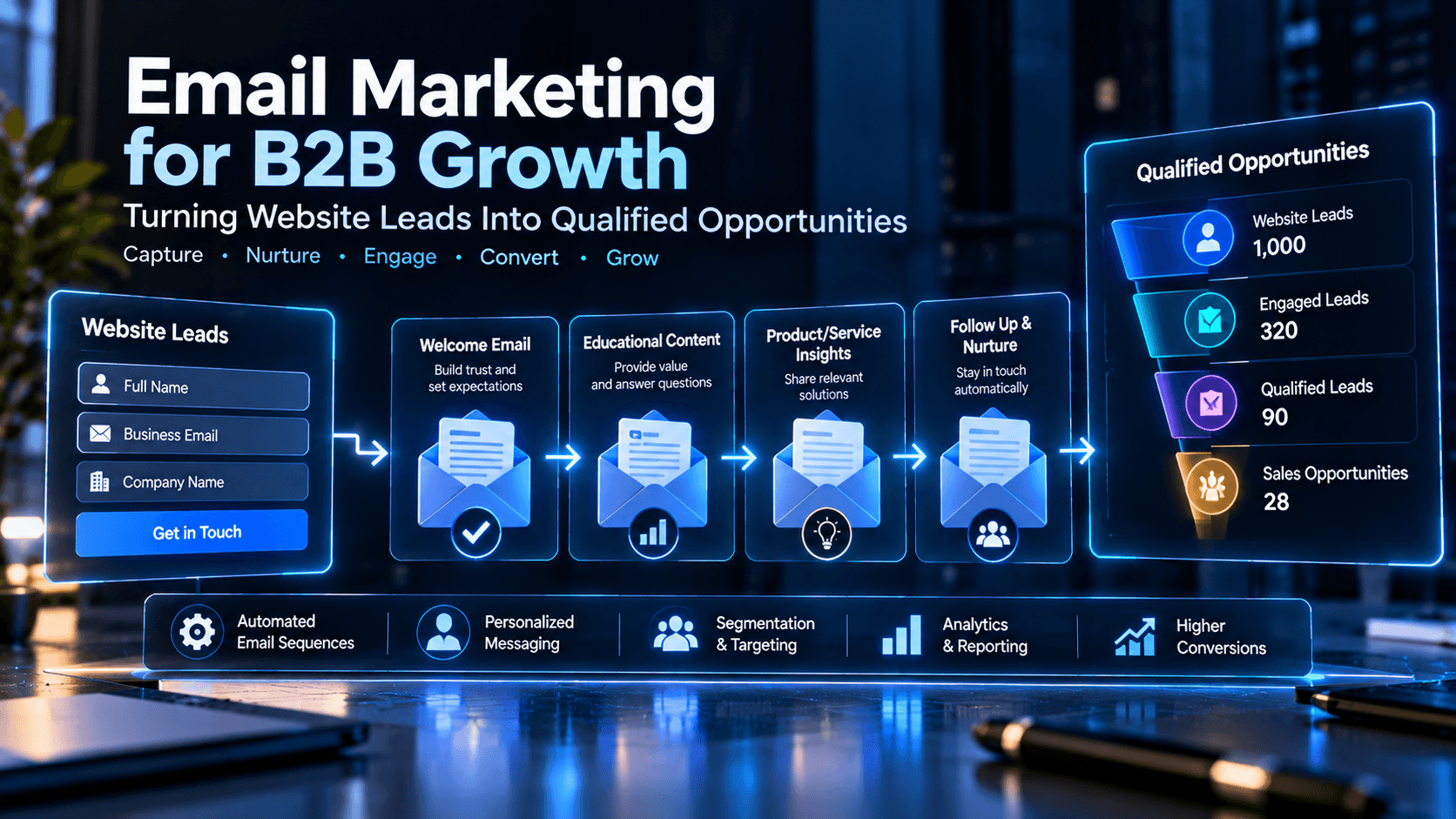
Email Marketing for B2B Growth: Turning Website Leads Into Qualified Opportunities
A form submission isn't a sales lead — it's a prospect who answered one question and is waiting to see if you noticed. Here's the actual sequence between an enquiry and a qualified opportunity, and where most B2B nurturing programs quietly fall apart.
Introduction
A website enquiry and a sales-qualified lead are not the same thing, even though a lot of B2B marketing software treats them as interchangeable the moment a form gets submitted. Someone filled in a field, got a confirmation email, and now sits in a CRM labeled "lead" — which tells a sales rep almost nothing about whether this person is ready for a conversation, still comparing options, or just downloaded a PDF and moved on with their day.
Email lead nurturing is the work that happens in the gap between those two states. It's not a newsletter, and it isn't cold outreach to people who never asked to hear from you — it's a structured, relevant sequence of communication with someone who already raised their hand, aimed at finding out what they actually need before handing them to a salesperson, or finding out they're not ready yet and shouldn't be handed over at all.
Most of what goes wrong here isn't a creative problem. It's a sequencing problem: leads get an automated "thanks for your interest" and then either silence or a sales pitch, with nothing in between that actually answers the question the person asked. This guide walks through the sequence that closes that gap — enquiry, segmentation, nurturing, qualification, handoff, measurement — and what to get right at each step.
What is B2B email lead nurturing?
Email lead nurturing is the ongoing, relevant email communication a business sends to a contact after they've expressed interest — typically through a website enquiry, content download, demo request, or similar action — with the goal of helping that contact move toward a genuine sales conversation, or determining that they're not a fit right now.
It's worth being precise about what this isn't. It isn't cold-email prospecting, which targets people who haven't engaged with the business at all. It isn't a general newsletter, which usually serves an existing audience rather than moving a specific lead toward a decision. And it isn't automation for its own sake — a sequence of emails firing on a timer regardless of what the person actually asked for is automation without nurturing.
The distinction that matters most: a lead is someone who took an action. A qualified opportunity is someone whose fit, intent, and timing have actually been assessed. Email nurturing is the mechanism that sits between those two states for longer B2B buying cycles, where a single form fill rarely means someone is ready to buy today.
Why website leads need a structured follow-up process
A form submission tells you someone was curious enough to type their email address into a box. It doesn't tell you whether they're the decision-maker, whether they're evaluating three competitors, or whether they're six months from budget approval. Treating every enquiry the same way — either an immediate hard sell or complete silence until someone remembers to follow up — wastes the ones that were actually ready and irritates the ones that weren't.
A few things matter here regardless of company size:
- Timely acknowledgment. The person should know their enquiry was received and what happens next, without that acknowledgment doubling as a sales pitch.
- Clear ownership. Someone — a person or a defined process — needs to be responsible for what happens to this contact next. An enquiry with no owner is the most common way leads go cold.
- Shared status definitions. Marketing and sales need to agree on what "qualified" actually means before a lead reaches that stage, not argue about it after a rep gets a bad handoff.
- Relevance over speed alone. Fast but irrelevant follow-up isn't much better than slow follow-up — it just demonstrates the irrelevance faster.
How to segment B2B website leads
Segmentation is what makes the difference between "relevant follow-up" and "a slightly more targeted mass email." The goal is to group leads by information that actually changes what you'd say to them next — not to create more lists for their own sake.
| Data point | Example | How it informs communication | Relevance or privacy note |
|---|---|---|---|
| Enquiry type | Demo request vs. general contact form | Determines whether the next email should be sales-facing or educational | Keep the distinction based on what they actually asked for, not an assumption |
| Stated problem | "Looking to reduce response time" | Lets follow-up speak to that specific problem instead of generic benefits | Use their own words where possible; don't over-interpret a short message |
| Service interest | Which product or service page they came from | Directs which case material or explanation is relevant | Avoid collecting more detail than the follow-up actually needs |
| Company type / industry | SMB vs. enterprise, or vertical | Shapes examples and depth of explanation | Only collect if it's genuinely used downstream |
| Role or job function | Marketing manager vs. founder | Changes the level of detail and who else needs to be looped in | Ask only if the form has a real reason to ask |
| Lead source | Paid search vs. referral vs. organic | Helps calibrate intent — a referral often arrives warmer than a cold ad click | Useful internally; rarely needs to be visible to the contact |
| Buying stage | Early research vs. active evaluation | Determines whether the next email should educate or compare options | Infer cautiously from behavior, not just a guess |
| Engagement signal | Opened three emails, clicked a pricing link | Suggests increasing readiness, worth a different next step | Treat as one signal among several, not a score on its own |
The common failure mode on both ends is worth naming: too little segmentation produces generic blasts that ignore what the person actually asked for; too much produces a form that asks for information you'll never use and that discourages people from finishing it. Segment on what changes the next email, and stop there.
How to create an effective B2B email nurturing sequence
There's no universally correct number of emails or fixed interval between them — a complex enterprise purchase and a straightforward service enquiry don't belong on the same schedule. What follows is a sequence of purposes, not a mandated timeline; the illustrative workflow table after it should be read as one adaptable example, not a template to copy verbatim.
Initial enquiry confirmation
Acknowledge what was actually requested, confirm what happens next, and avoid turning the very first email into a pitch. This is a reassurance step, not a conversion opportunity.
Educational follow-up
Address the problem the person indicated, with information that would be useful even if they end up choosing a competitor. This is where credibility gets built or lost.
Relevant supporting evidence
Where genuine, verifiable case material, customer results, or demonstrations exist, this is the point to introduce them — only material that's actually true and attributable, never a hypothetical dressed up as a result.
Objection handling
Address the concerns a prospect in this situation plausibly has, with substantive information rather than pressure. This stage benefits most from actually knowing the recurring questions your sales team hears.
Sales conversation invitation
Once the sequence has demonstrated relevance and the signals suggest readiness, a direct, low-pressure invitation to talk makes sense — not as the first message, and not disconnected from everything that came before it.
Re-engagement and suppression
Contacts who've gone quiet need a deliberate decision, not indefinite drip emails. A re-engagement attempt, followed by suppression if there's still no response, keeps the list honest and protects sender reputation.
Illustrative workflow (example only — not a fixed schedule):
| Stage | Purpose | Trigger | Reader's actual need | Appropriate next action |
|---|---|---|---|---|
| Confirmation | Acknowledge the enquiry | Form submission | Reassurance that the enquiry landed | Send once, promptly |
| Educational | Build relevance and trust | A few days after confirmation | Useful information about their stated problem | Share a resource tied to what they asked |
| Evidence | Support the claim with something real | After initial engagement | Evidence the solution actually works | Share a genuine case or example, if one exists |
| Objection handling | Address likely hesitations | Mid-sequence or on request | Answers to unspoken concerns | Address the 1-2 most common objections for this segment |
| Sales invitation | Offer a direct conversation | When engagement signals readiness | A clear, low-pressure next step | Invite a call or meeting |
| Re-engagement | Check in on silence | After a defined period of no activity | A reason to re-engage or an easy way to opt out | One attempt, then suppress if there's no response |
How to personalize B2B emails without being generic
A first name in the subject line is not personalization — it's a mail-merge field. Personalization that actually changes outcomes draws on what the person enquired about, the problem they stated, their company context (when it's legitimately known), what content they've already engaged with, and their apparent buying stage.
A generic version of a follow-up email might read: "Thanks for your interest in our services. Here's an overview of what we offer." A more relevant version, built from the same template but using what the enquiry actually said, reads closer to: "You mentioned you're trying to cut down response time on inbound enquiries — here's how two different approaches to that problem compare, since the right one depends on your current volume." The second version isn't longer or cleverer; it's just responsive to what the person actually said, which is the entire difference.
Avoid overcorrecting into invasive personalization — referencing data a prospect didn't knowingly share, or detail that reads as surveillance rather than attentiveness. The standard is simple: personalize based on what they told you or clearly showed you, not what you could technically infer.
How email automation supports B2B lead nurturing
Automation's job is to make the right follow-up happen reliably, not to replace judgment about what that follow-up should say. Typical mechanics include form-submission triggers, behavior-based triggers (a pricing-page visit, a specific link click), sequence automation, workflow branching by segment, CRM-linked contact history, and suppression logic for unsubscribed or disqualified contacts.
What automation shouldn't take over: a prospect requesting a meeting, asking a specific question, raising a complex objection, or sending any other signal that this particular enquiry needs a person, not a template. A high-intent message that gets an automated reply instead of a human one is a worse outcome than a slightly slower human reply would have been.
How to qualify leads and hand them to sales
Marketing-qualified lead (MQL) and sales-qualified lead (SQL) are internal shorthand, not fixed industry definitions — what counts as an MQL at one company might not clear the bar at another, and that's fine as long as marketing and sales have actually agreed on the definition rather than assuming they share one.
A workable starting point: an MQL is a contact whose profile and engagement suggest they're a plausible fit and are actively consuming relevant content, without yet showing direct buying intent. An SQL has shown a more direct signal — requesting a demo, asking about pricing, or describing a specific need that matches what's sold — and is judged ready for a sales conversation. A sales opportunity is what an SQL becomes once a rep has engaged and confirmed there's a real, qualifiable deal to pursue.
Avoid importing an arbitrary point-based lead-scoring system from somewhere else and assuming it applies here. A scoring model only works when it's built from your own sales team's actual observations about which signals have correlated with real opportunities — and even then, it should get revisited periodically rather than treated as permanent. The handoff itself needs a clear owner, a documented reason the lead is considered ready, and a way for sales to flag back to marketing when a "qualified" lead clearly wasn't.
How to measure B2B email marketing performance
Open rate alone answers almost none of the questions that matter, and treating it as the headline metric is one of the more common ways nurturing programs optimize for the wrong thing. A useful measurement approach looks at four separate layers, because each answers a different business question:
| Measurement layer | Metrics | Business question |
|---|---|---|
| Delivery | Delivery rate, bounce rate, spam complaint rate | Are emails reaching intended recipients? |
| Engagement | Click-through rate, meaningful replies, relevant clicks | Are recipients taking meaningful action? |
| Lead quality | MQLs, SQLs, qualification rate | Are leads becoming more sales-ready? |
| Business outcomes | Opportunities created, sales handoff rate, pipeline and revenue contribution where reliably attributable | Is nurturing producing outcomes the business actually cares about? |
Open-rate reporting in particular has become less reliable than it once was — privacy features on major email clients, automated image loading, and other background activity can register as an "open" without a human ever reading the message. That doesn't make opens useless; a sharp, sustained drop in opens for a specific segment is still worth investigating. It does mean opens should be read as a directional signal, not a standalone measure of interest or success.
The hardest honest limitation to state plainly: attributing a closed deal to one specific email, in a buying journey that might span weeks or months and multiple touchpoints, is rarely clean. Pipeline and revenue contribution are worth tracking, but they deserve the same caution as any other multi-touch attribution problem — a single nurturing email is one input among many, not provably the cause of the outcome.
Email deliverability and compliance essentials
None of the nurturing above matters if the emails don't reach the inbox, and getting this wrong has gotten more consequential as Gmail and Yahoo have tightened their bulk-sender requirements.
CAN-SPAM, the US legal baseline, is an opt-out framework, not an opt-in one — it's a common misconception worth correcting directly: the FTC's compliance guide does not require prior opt-in consent before sending commercial email to a B2B contact. What it does require: accurate header and routing information identifying the real sender; a subject line that isn't deceptive; clear identification that the message is an advertisement; a valid physical postal address; and a working, clearly explained opt-out mechanism that must stay functional for at least 30 days after sending and be honored within 10 business days. You can't charge a fee or demand more than an email address to process an opt-out, and using a third-party sender doesn't transfer away your legal responsibility — the business whose product is promoted and the company that sends the message can both be held liable.
Gmail's current sender requirements, which took effect in February 2024, apply to anyone sending to personal Gmail accounts and set a higher bar for bulk senders — defined as sending close to 5,000 messages or more to Gmail accounts within a 24-hour period, counted across a domain including subdomains, with bulk-sender status applying permanently once that threshold is met even once. All senders need at least SPF or DKIM; bulk senders need SPF, DKIM, and a DMARC record (minimum policy `p=none`), with the From: header domain aligned to the SPF or DKIM domain. Bulk senders must also support one-click unsubscribe (the RFC 8058 List-Unsubscribe header, not just a mailto link or a link buried in the body) and keep spam complaint rates below 0.3%, with Google's own best-practice guidance recommending staying under 0.1%.
Yahoo's requirements run on a similar structure: SPF or DKIM for all senders, with bulk senders needing both plus a DMARC policy of at least `p=none`; a functioning unsubscribe mechanism, with the one-click RFC 8058 method recommended and unsubscribe requests honored within 2 days; and a spam complaint rate kept below 0.3%, calculated from mail that actually reached the inbox.
Practical list hygiene sits underneath all of this: monitor bounce and complaint signals, remove invalid addresses promptly, periodically reconfirm genuinely inactive subscribers rather than letting them sit indefinitely, and never buy or scrape an email list — beyond the deliverability damage, a list nobody opted into is the fastest way to generate the complaint rate that gets a domain blocklisted.
One more distinction worth holding onto: CAN-SPAM, Gmail's guidelines, and Yahoo's guidelines are three different kinds of requirement — one is US federal law, the other two are platform-specific technical and policy requirements from mailbox providers. Meeting one doesn't automatically satisfy the others, and a business sending to contacts outside the US should also check whether stricter local rules apply, since this guide covers the US framework specifically.
A practical B2B email lead-nurturing checklist
- (Unchecked) Confirm every website enquiry has a defined next step, not just an auto-reply.
- (Unchecked) Assign clear ownership for each new lead.
- (Unchecked) Record the lead source and enquiry type in the CRM.
- (Unchecked) Segment by what will actually change the next message, not for its own sake.
- (Unchecked) Avoid collecting data fields the follow-up won't use.
- (Unchecked) Draft an initial confirmation that reassures without pitching.
- (Unchecked) Build an educational follow-up tied to the stated problem.
- (Unchecked) Use only genuine, verifiable supporting evidence, clearly sourced.
- (Unchecked) Prepare objection-handling content based on real recurring questions.
- (Unchecked) Define what a reasonable sales-conversation invitation looks like for this segment.
- (Unchecked) Set a re-engagement step for contacts who've gone quiet.
- (Unchecked) Set a suppression rule for contacts who don't respond to re-engagement.
- (Unchecked) Confirm automation triggers match actual behavior, not just time delays.
- (Unchecked) Flag high-intent signals for human follow-up instead of routing them into automation.
- (Unchecked) Agree on MQL and SQL definitions with sales, in writing.
- (Unchecked) Document the handoff process and who owns it on each side.
- (Unchecked) Set up SPF, DKIM, and DMARC, and confirm alignment.
- (Unchecked) Implement one-click unsubscribe and honor requests within the required window.
- (Unchecked) Monitor bounce rate, spam complaint rate, and list hygiene regularly.
- (Unchecked) Review MQL/SQL/opportunity definitions periodically rather than treating them as permanent.
Conclusion
Nurturing isn't a single campaign — it's the connective process between a form submission and a sales-ready conversation, built on segmentation that's actually used, follow-up that answers the question someone asked, and a qualification standard that marketing and sales both agree on before a lead changes hands. None of that depends on expensive software; it depends on the sequence being right.
If your website is generating enquiries that aren't converting into qualified conversations, Belk Digital can help you build a structured lead-nurturing and follow-up process around the leads you're already getting.
Frequently Asked Questions
Need Expert Help with This?
If you’re looking to implement these strategies for your business, our team can help you plan, build, and scale with confidence.
ContactReady to Transform Your Digital Presence?
Let's discuss how we can help you achieve your digital goals and create an exceptional online presence.