
Can Peptide Suppliers Advertise on Google Ads or Meta? A 2026 Eligibility Checklist
An RUO disclaimer on your site doesn't answer what ad platforms actually ask. Learn what Google Ads and Meta require before committing ad budget.
Introduction
Most peptide suppliers don't find out whether they're eligible to advertise until after the campaign is built, the budget is loaded, and the first batch of ads comes back disapproved. By then the question has already cost them something. The better order is to answer it first: can this specific business, selling this specific product, to this specific audience, actually run paid ads on Google or Meta — and what has to be true for that to hold up under review?
The short version is that it depends, and it depends on more than most suppliers expect. Google Ads has a named policy category for "suppliers of antibodies, peptides, and compounds for commercial labs," with a certification process and a short list of eligible countries. Meta's restricted-goods framework covers drugs and pharmaceuticals broadly, but its public documentation doesn't spell out an equivalent commercial-laboratory carve-out for peptide suppliers specifically — which means the honest answer on Meta is less settled than it is on Google. Neither platform treats a research-use-only label as a free pass, and neither platform's rules transfer to the other. This guide walks through what each platform's current policy actually says, what a supplier needs to check before spending anything, and what to do when an ad gets rejected anyway.
What this guide doesn't do: tell you that your business is definitely eligible, hand you a workaround for a rejected ad, or substitute for a platform's own certification review or a conversation with legal counsel if your product's classification is genuinely unclear. What it does do is lay out the actual policy text, the real distinctions inside it, and a practical sequence for checking your own position before you commit ad spend to finding out the hard way.
RUO labeling is not an advertising exemption
"Research use only" is a labeling and intended-use claim. It tells a buyer, and in principle a regulator, that the product isn't intended for human consumption. It doesn't tell an ad platform anything about whether the business, the product category, the ad copy, or the destination page meets that platform's advertising rules — those are four separate questions, and a platform can say no to any one of them regardless of how the product is labeled.
That distinction matters because a lot of the confusion in this space comes from treating "RUO" as if it were a compliance status on an advertising platform, the way a verified badge or a certified-reseller mark would be. It isn't. A business can have an airtight RUO labeling practice, a compliant website, and still be ineligible to advertise a given product in a given country because of how the platform classifies the product category itself. The reverse is also true: a product that's genuinely fine to sell can still be advertised under the wrong category, with the wrong claims, or from an uncertified account, and get rejected for reasons that have nothing to do with whether the product itself is legitimate.
This guide focuses on advertising eligibility specifically — not on the separate questions of FDA framework, state-level research-chemical statutes, or payment-processor underwriting, which deserve their own review and their own specialists.
RUO reflects intended product use, not an advertising network exemption.
Networks evaluate account type, compound category, copy, and landing pages independently.
Strict labeling practices do not override platform-level product restrictions.
Advertising eligibility remains distinct from regulatory sale authorizations.
Identify your advertiser and product category first
Before checking either platform's policy, know which bucket your business actually falls into, because the rules genuinely differ by advertiser type. A business selling research peptides to commercial laboratories is not automatically treated the same as a compounding pharmacy, a telehealth clinic prescribing peptide therapies, a manufacturer of a branded over-the-counter product, or a general wholesale distributor — even if all four sell something that could loosely be called "a peptide."
Google's own policy structure makes this split explicit: pharmaceutical manufacturers sit under one heading with their own certification and country rules, while suppliers of antibodies, peptides, and compounds for commercial labs sit under a separate "other manufacturers and suppliers" heading with a different, shorter list of eligible countries. Getting this classification right is the first real decision point — applying under the wrong category is a common reason certification gets denied before the ad content is even reviewed.
Distinguish research suppliers from compounding pharmacies and telehealth clinics.
Select the exact regulatory tier before initiating advertising applications.
Recognize that Google classifies commercial laboratory suppliers under a distinct heading.
Avoid category misclassification that triggers immediate certification rejection.
Can peptide suppliers advertise on Google Ads?
Yes, with real limits, and the limits are specific rather than general.
Google Ads' current Pharmaceutical manufacturers policy names "suppliers of antibodies, peptides, and compounds for commercial labs" as their own category, separate from pharmaceutical manufacturers proper. That category may advertise only in Canada and the United States — not the longer list of countries available to manufacturers of approved prescription or over-the-counter medicines. Pharmaceutical manufacturers themselves must be certified by Google before any ad serves, applying at the child-account level with a certified domain; the peptide-and-compound-supplier category sits under the same certification requirement in practice, since it's grouped with the other certified manufacturer and supplier categories on the same policy page.
Separately, Google's Healthcare and medicines policy lays out what's restricted outright regardless of category: promotion of prescription drug sales without proper licensing, prescription opioid painkillers (full prohibition, with narrow public-health and certified-treatment-provider exceptions), speculative and experimental treatments, and cell and gene therapies outside FDA-licensed products promoted by the license holder. None of that page's text uses the word "peptide" or "research chemical" directly — the peptide-specific language lives in the pharmaceutical manufacturers policy, not here — but the broader restrictions still apply if a peptide ad strays into claims about treating a condition or replacing a prescription drug.
Google's Unapproved pharmaceuticals and supplements page, which lists specific disallowed products, doesn't name peptides or research chemicals either. Its examples are mostly branded weight-loss products, unapproved sleep aids, and anabolic-steroid-type compounds. That's a meaningful gap worth being precise about: the absence of "peptide" from that list isn't the same as a blanket allowance — it just means peptides aren't flagged in that particular example list the way certain named steroid products are.
The certification itself goes through Google's application process for certain products and services: check your ad status under Campaigns > Ads for a "Certificate required" notice, then apply either through the in-account Policy Center (where that option has rolled out) or through the Help Center application links. Google doesn't publish a fixed processing timeline for this category, and approval depends on your actual account, documentation, and destination domain — not just on filling out the form correctly.
Google explicitly names commercial lab peptide suppliers as an eligible category.
Targeting is strictly restricted to Canada and the United States only.
Mandatory advertiser certification is enforced at the individual child-account level.
Destination landing pages must be completely free of medical or treatment claims.
Can peptide suppliers advertise on Meta?
This is the harder question to answer cleanly, and the honest answer is that it's less settled than Google's.
Meta's Advertising Standards place drugs and pharmaceuticals in its restricted goods and services category, with dedicated sub-policies covering prescription drugs, over-the-counter drugs, and online pharmacies specifically. That structure signals a tiered system — different rules for different drug-adjacent categories, similar in spirit to Google's approach of splitting pharmaceutical manufacturers from other supplier types. What Meta's public Drugs and Pharmaceuticals policy page does not do, in anything we could locate in its published documentation, is name a specific commercial-laboratory or research-supplier category the way Google's policy does for peptide suppliers. There's no published equivalent to "suppliers of antibodies, peptides, and compounds for commercial labs may advertise in these two countries."
That absence cuts two ways, and it's worth being direct about both rather than picking the more convenient one. It could mean Meta simply hasn't published a dedicated carve-out and evaluates these businesses under its general drugs-and-pharmaceuticals restrictions, likely requiring the same kind of authorization or licensing review it applies to other drug-adjacent advertisers. It could also mean a peptide supplier's ads get evaluated in a gray zone where the outcome depends heavily on how the reviewer classifies the specific product and claims, with less predictability than Google's named category offers. Neither of those is the same as "Meta allows it" or "Meta prohibits it" as a blanket rule, and claiming either would overstate what the published policy actually establishes.
The practical move, given that gap, is to apply through Meta's own business help channels before building a campaign — not to assume that passing Google's certification carries over, and not to assume silence in Meta's documentation means permission. A platform's written policy and what it actually approves on review can diverge, and that gap is exactly what a pre-launch inquiry is for.
Meta publishes no named commercial-laboratory peptide supplier category.
Public policies provide no published equivalent to Google's peptide carve-out.
Eligibility is unresolved in public documentation and subject to manual review.
Advertisers must confirm eligibility directly with Meta prior to allocating spend.
Google Ads vs. Meta: Key differences
The two leading ad networks approach peptide advertising eligibility from fundamentally different starting points:
| Policy question | Google Ads | Meta | What the advertiser must verify |
|---|---|---|---|
| Named peptide-supplier category? | Yes — "suppliers of antibodies, peptides, and compounds for commercial labs," under Other manufacturers and suppliers | Not identified in Meta's published Drugs and Pharmaceuticals policy | Which category your business actually falls under on each platform |
| Eligible countries for that category | Canada and United States only | Not specified for this category in public documentation | Confirm your target geography against the platform's current list before launch |
| Certification required | Yes, for pharmaceutical manufacturers and related supplier categories, applied for per child account | Not published specifically for this category; general restricted-goods review likely applies | Whether your account needs certification, and which category to apply under |
| Destination-page review | Must be fully functional, globally accessible, and free of terms you aren't certified for | Not detailed publicly for this category | Landing-page language, especially anything resembling a treatment or dosing claim |
| Where the published policy is silent | Peptides aren't named in the Unapproved pharmaceuticals example list | No dedicated commercial-lab carve-out found in public policy | Treat silence as unresolved, not as permission |
Google maintains a codified category; Meta lacks published specific guidance.
Google limits geography strictly to US & Canada; Meta country limits are unpublished.
Both networks enforce strict landing-page scrutiny and account-level oversight.
Never assume policy approval or certifications transfer between ad networks.
The pre-launch advertising eligibility checklist
Before allocating budget or designing creative assets, execute this ten-point compliance sequence:
- Confirm your advertiser category. Commercial-lab supplier, pharmaceutical manufacturer, distributor, clinic, or something else — the category determines which policy applies, on both platforms.
- Confirm your product category and intended use. Match the product description on your site to how you intend to describe it in ads; mismatches between the two are a common source of rejection.
- Pull the current official policy for each platform you're targeting. Policy pages change; re-check immediately before launch, not from a saved screenshot.
- Check geographic eligibility separately for each platform. Google's peptide-supplier category is Canada and US only; don't assume Meta's geography matches.
- Determine whether certification or authorization applies, and apply early. Google's certification process doesn't have a published fixed timeline — build in lead time.
- Audit your ad copy and claims against the restricted-terms list. Language implying treatment, cure, or a prescription-drug substitute is a flag on either platform.
- Audit your creative assets and targeting for the same claims. A compliant headline paired with a non-compliant image or audience setting can still trigger rejection.
- Review your destination domain and landing page. Confirm it's fully functional, accessible in your target region, and free of language you aren't certified for.
- Check your account status and any existing policy notifications. A prior unrelated violation on the account can complicate a new certification application.
- Document the review before you launch. Note which policy version you checked, the date, and who signed off — useful if a rejection needs to be appealed later and you need to show what you actually verified.
Completing this list improves your odds of a clean review. It doesn't guarantee approval on either platform — that decision sits with Google's or Meta's own reviewers, applied to your specific account and content.
Audit advertiser categorization and intended-use alignment across assets.
Verify geographic boundaries (Google is restricted to US and Canada).
Scrutinize ad copy, visuals, and landing pages for implied medical claims.
Maintain a documented compliance trail prior to campaign submission.
What to do if an ad is disapproved
Start by reading the specific policy citation in the disapproval notice rather than guessing at the cause. The notice usually names the exact policy, which tells you whether the issue is the ad creative, the product category itself, the landing page, the account's certification status, or the targeted geography — and those have different fixes.
If the issue is a correctable one — a claim in the copy, an unclear landing page, a missing disclosure — fix that specific element and resubmit through the platform's standard review flow. If the issue is categorical, such as targeting a country outside your certified list or applying under the wrong supplier category, no amount of copy editing will resolve it; the fix is a corrected application, not a resubmission of the same ad. Repeatedly resubmitting the same ad without addressing the cited policy tends to slow down future reviews rather than speed up the current one.
If the disapproval turns on how your product is classified, or whether a particular claim crosses into a regulated statement, that's the point to bring in a qualified legal or regulatory adviser rather than iterating on ad copy by trial and error.
Inspect the specific policy citation in the rejection notice before taking action.
Distinguish correctable ad copy issues from structural category disqualifications.
Avoid repeated identical resubmissions that trigger automated account penalties.
Engage specialized legal counsel when product classification is in dispute.
When to seek specialist advice
Platform support can usually tell you why a specific ad was rejected and what policy applied. They generally can't tell you how your product should be classified under FDA or state law, or whether a specific claim in your copy carries regulatory risk beyond the ad platform's rules — that's a legal and regulatory question, not an advertising-policy one, and it's worth treating as a separate conversation with someone qualified to answer it.
For many peptide suppliers currently restricted to a narrow set of ad-eligible countries, organic search visibility (SEO) serves as a resilient alternative: organic discovery is not gated by platform advertiser certification, though it requires strict technical and content compliance.
Platform support clarifies policy mechanics but does not provide legal advice.
Consult regulatory counsel regarding statutory product classification boundaries.
Deploy technical organic SEO as a resilient channel independent of ad approvals.
Maintain strict separation between marketing optimization and legal compliance.
Before you spend the ad budget
Eligibility here is conditional, not categorical — it depends on your advertiser type, your product category, your target geography, your certification status, and what your destination page actually says, checked against each platform's current policy rather than last year's version of it. None of that review guarantees an approved campaign, but skipping it is how suppliers end up paying to find out the hard way.
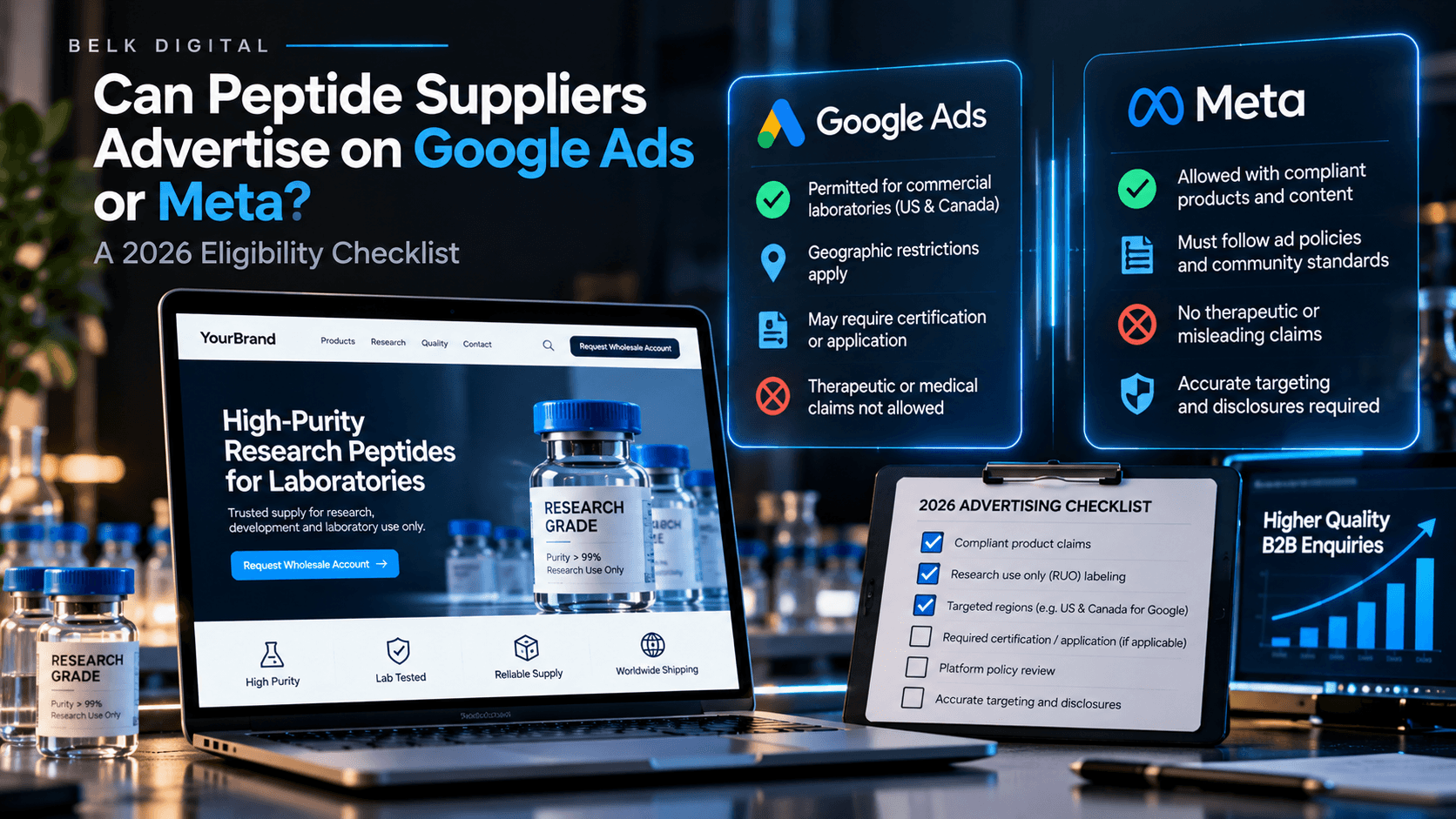
*Editorial Note on Diagram:* The accompanying graphic depicts an advertising compliance dashboard displaying a green checkmark for Meta. Note that Meta's published advertising policies do NOT define a dedicated commercial-laboratory peptide supplier category. Eligibility on Meta remains unconfirmed in public documentation and must be verified directly with Meta before campaign launch. RUO labeling does not constitute an advertising exemption on either network.
If you want a second set of eyes on your ad messaging, landing pages, or policy positioning before you launch a restricted-product campaign, reach out to Belk Digital to talk through a pre-launch website and campaign review.
Primary Documentation & Authoritative Resources
- Google Ads Policy: Pharmaceutical Manufacturers — Official rules and certification for suppliers of antibodies, peptides, and compounds.
- Google Ads Policy: Healthcare and Medicines — Overview of global restrictions on prescription medicines and speculative therapies.
- Google Ads Policy: Unapproved Pharmaceuticals and Supplements — Reference directory of disallowed substances and claims.
- Google Ads Application Process: Products & Services Certification — Official portal for child-account advertising certificates.
- Meta Transparency Center: Advertising Standards Overview — Core governance framework for commercial promotions.
- Meta Advertising Policy: Drugs and Pharmaceuticals — Public criteria for prescription, OTC, and online pharmacy promotions.
Frequently Asked Questions
Need Expert Help with This?
If you’re looking to implement these strategies for your business, our team can help you plan, build, and scale with confidence.
ContactReady to Transform Your Digital Presence?
Let's discuss how we can help you achieve your digital goals and create an exceptional online presence.