
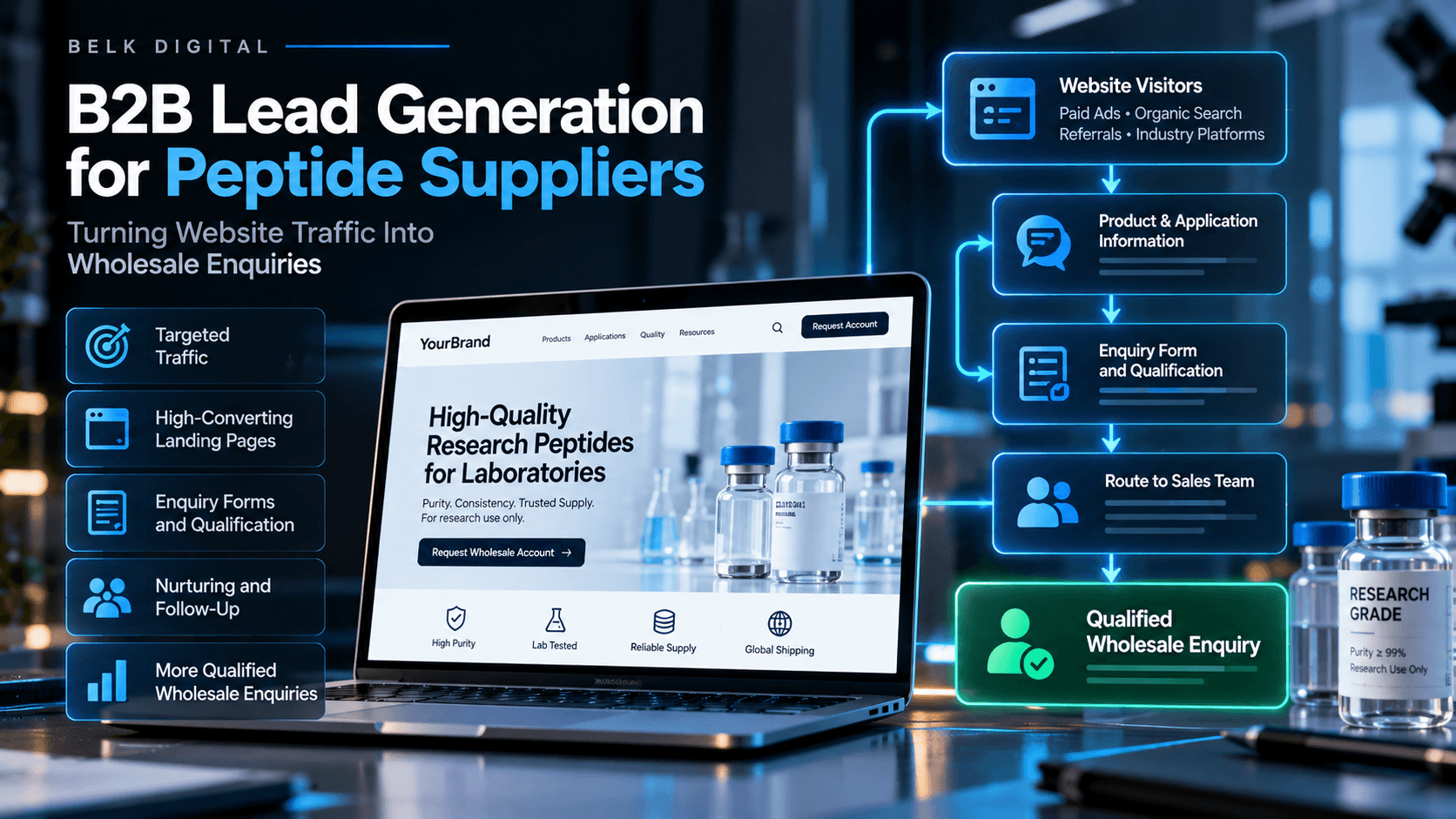
B2B Lead Generation for Peptide Suppliers: Turning Traffic Into Wholesale Enquiries
A practical guide for peptide suppliers on turning website traffic into qualified wholesale enquiries, with buyer-specific messaging, form qualification, and follow-up workflows.
Introduction
A peptide supplier can do everything right on paper — rank for the terms that matter, run a steady ad budget, post regularly — and still watch the wholesale pipeline stay thin month after month. The instinct is to blame the traffic number. Usually that's the wrong diagnosis. The traffic was never the bottleneck. The gap between someone landing on the site and someone submitting a real, qualified wholesale enquiry is.
This isn't a general B2B marketing article with "peptide" dropped into it. It's a walkthrough of the specific pre-sale process: who to target, how to get them to the site, what actually turns a visit into an enquiry, how to sort what comes in, and how to follow up without losing people. It stops at the point a buyer gets approved and starts ordering — what happens after that, inside the buyer portal itself, is covered separately. This is a marketing and conversion guide, not legal or regulatory advice.
Traffic, enquiry, qualified lead — these are not the same number
Most dashboards track one number (sessions) and call it progress. That's the first thing to fix, because five distinct things happen between a stranger finding the site and a signed wholesale account, and conflating any two of them hides where the pipeline is actually leaking.
- Visitor — landed on the site. Tells you nothing about buying intent on its own.
- Enquiry — took an action: submitted a form, asked for pricing, requested a spec sheet. The first real signal.
- Qualified lead — an enquiry that actually fits the buyer profile and has a credible reason to purchase.
- Opportunity — a qualified lead in active conversation about a specific order or account setup.
- Customer — approved and ordering.
Here's the part that trips people up: traffic can go up every month while qualified enquiries go down, if the growth is coming from the wrong audience or the path from visitor to enquiry is weak. Watching session count and calling it pipeline health is like watching foot traffic outside a store and calling it sales.
Visitor: landed on the site without intent confirmation.
Enquiry: initial action such as a quote request or spec inquiry.
Qualified lead: verified fit against commercial buyer criteria.
Opportunity: active commercial discussions regarding order terms.
Not every wholesale buyer wants the same thing — stop writing for all of them at once
Peptide wholesale buyers aren't one audience. A research lab, a reseller, and a formulator are evaluating a supplier on different criteria, and messaging built to please all three usually convinces none of them.
| Buyer type | What actually moves them |
|---|---|
| Research labs and institutions | Documentation rigor, lot traceability, batch-to-batch consistency |
| Smaller resellers and distributors | Pricing tiers, minimum order quantities, margin |
| Formulators and compounders | Specification detail, purity data, consistency across orders |
| Clinics and medspas (where applicable) | Supply reliability, account support, easy reordering |
The useful exercise isn't listing all four — it's picking the one or two a given business is actually built to serve well. Product range, order minimums, documentation depth, and support model all skew toward some buyer types more than others. Write every subsequent page for that buyer specifically, not for a generic "businesses that buy peptides" composite that doesn't exist.
Research labs demand lot traceability and analytical documentation.
Resellers focus on tier pricing, margins, and minimum order quantities.
Formulators require strict purity data and reproducible batch consistency.
Clinics prioritize delivery reliability, responsive support, and reordering.
Getting the right traffic matters more than getting more of it
More sessions from the wrong audience doesn't move the needle. The goal is visitors who already match the profile above and are close enough to a decision to act on what they find.
Search intent. Content built around the questions a wholesale buyer is actually asking — sourcing criteria, documentation standards, account setup — tends to attract people further along than generic brand pages do. The technical and trust-signal side of ranking a peptide site is covered in more depth here.
A dedicated wholesale landing page. Not a repurposed product page — a page built specifically for "become a wholesale buyer" intent, so visitors and search engines both get a clear destination instead of having to piece eligibility and process together from scattered content.
Industry channels. Trade associations, directories, and professional communities where lab buyers and formulators already gather tend to produce fewer visits but higher intent than broad-audience channels.
Referrals and partnerships. Existing wholesale accounts and complementary suppliers are an underused source of warm introductions compared to cold acquisition.
Paid acquisition, where eligible. Platform and payment-provider eligibility for this product category shifts, so confirm current policy directly with each platform before building spend around it. RUO labeling doesn't settle that question on its own.
All five get judged the same way: whether they bring buyers who match the profile, not by raw volume.
Target commercial search intent rather than consumer informational queries.
Deploy dedicated wholesale landing pages engineered for B2B qualification.
Engage niche trade associations and specialized B2B life science directories.
Verify paid advertising platform compliance prior to allocating ad spend.
A qualified visitor still won't enquire if the page doesn't confirm they're in the right place
Someone who matches the buyer profile and lands on the site still has to be convinced, fast, that they're looking at the right thing.
Message match. If the headline doesn't echo whatever brought the visitor there — a search query, an ad, a referral link — a surprising number of otherwise-qualified visitors just leave. This single mismatch accounts for more lost enquiries than any form field ever will.
Say who it's for, plainly, near the top. Not brand language — who the wholesale program serves and what actually distinguishes the supplier: documentation standards, catalog breadth, account support.
Specifics beat adjectives. "High quality" and "trusted supplier" are what every competitor's page says too. Testing methodology, lot traceability, typical turnaround — those are differentiators because they're specific.
One action, not five. A page offering several competing calls to action makes the visitor choose, and a choice is a reason to leave. One primary path: request wholesale access.
Enough to act on, not a full catalog dump. The landing page's job is getting a qualified visitor to start an enquiry — not answering every possible question before they do. Depth belongs in the conversation that follows.
Ensure tight message match between incoming traffic source and page headline.
State commercial buyer eligibility clearly above the fold.
Highlight specific testing methodologies, lot traceability, and lead times.
Enforce a single, focused call to action rather than competing conversion paths.
Every field on the enquiry form should earn its place
A longer form doesn't produce better leads. It produces fewer submissions from people who were close to converting but gave up partway through. Each field should exist because sales actually uses it to prioritize or route the enquiry — nothing else.
A reasonable starting set:
- Business name
- Business contact details (name, role, email, phone)
- Business type (lab, reseller, distributor, formulator, clinic)
- Product or category of interest
- Anticipated volume or order frequency, where it genuinely affects routing or pricing
- Geographic market, when it affects fulfillment or compliance
Leave off anything personal or sensitive the sales process doesn't actually use. Two techniques help balance qualification against friction: a short initial form followed by a more detailed step (or a sales conversation) rather than asking for everything up front, and progressive profiling — collecting more detail over subsequent touchpoints instead of one long form. Every field should also carry a clear label and, where it might feel intrusive (anticipated volume, say), a brief stated reason for asking.
Capture business entity, role, professional email, and direct phone number.
Filter by buyer segment (commercial laboratory, distributor, compounder).
Collect projected order volumes only where pricing thresholds depend on it.
Utilize progressive profiling across touchpoints rather than exhaustive intake.
Not every enquiry deserves the same next step
MQL and SQL get thrown around as if they mean the same thing everywhere. They don't — organizations define the exact thresholds differently, and no outside article can hand a supplier a universal scoring model. What does transfer: MQL (marketing qualified lead — real interest shown, hasn't engaged sales yet), SQL (sales qualified lead — ready for a direct conversation), and opportunity (an SQL in active discussion about a specific order) are useful shorthand for internal tracking, nothing more.
The logic that actually holds up across businesses: score or route each enquiry on fit against the defined buyer profile, combined with intent signals in the submission itself. A lab requesting a detailed spec sheet for a specific compound and volume is a stronger signal than a generic "tell me more." A consistent, documented way of making that call matters more than which specific scoring model gets used.
Establish distinct operational definitions for MQL, SQL, and Active Opportunity.
Evaluate commercial fit based on institutional domain and business profile.
Weight compound-specific documentation requests higher than general inquiries.
Document routing criteria so sales and marketing apply identical qualification rules.
An enquiry that sits unanswered has already been declined
Whatever the eventual reply says, a multi-day silence reads as a no.
Ownership from the moment it arrives. Not a shared inbox where responsibility is ambiguous — a named owner, immediately.
A defined first-touch workflow. What the first reply covers (acknowledgment, basic qualifying questions) versus what's held for the fuller sales conversation, so it doesn't overwhelm or underwhelm.
Follow-up that answers the next question, not "just checking in." A short sequence addressing documentation, pricing structure, and account setup outperforms a generic nudge.
Status tracked through to CRM handoff. If an enquiry only lives in an inbox or someone's memory, it's not trackable — and it's not measurable either, which matters for the next section.
Consent and applicable privacy obligations respected in every follow-up touch.
Re-engagement for leads that are qualified but not ready yet. A periodic, low-pressure touchpoint — new documentation, a relevant update — keeps the business visible without forcing a premature push.
There's no universal response-time benchmark that applies to every business and buyer type. The right cadence comes from the supplier's own sales cycle and data over time, not a borrowed playbook.
Assign immediate individual ownership upon receipt of every B2B enquiry.
Implement structured first-response templates answering initial qualification points.
Provide value-driven follow-ups focused on lot documentation and account setup.
Maintain complete CRM audit trails and respect regulatory data privacy standards.
Traffic doesn't tell you whether the pipeline is healthier than last quarter — these numbers do
| Metric | What it actually shows |
|---|---|
| Search impressions and organic clicks | Visibility and initial interest through the channels above |
| Relevant landing-page visits | Whether acquisition is reaching the right buyer profile |
| Enquiry starts vs. completed submissions | Where the form itself may be losing interested visitors |
| Qualified-enquiry rate | The share of enquiries that actually match the buyer profile — the core health number |
| Lead source and campaign attribution | Which channels produce enquiries that convert, not just enquiries |
| Lead-to-opportunity progression | Whether qualified leads are advancing or stalling after first contact |
| Sales outcomes, where the data is reliable | The real test, where attribution back to source holds up |
Two things to keep honest here. Attribution gets weaker the further a buyer is from that first click — a wholesale decision usually involves several visits and internal discussion before an enquiry ever happens, so single-touch attribution understates channels that influence early. And metric definitions need to stay fixed over time, or month-over-month comparisons are meaningless. Decide what "qualified enquiry" means once, write it down, and don't quietly redefine it three months later because the number looked better that way.
Monitor qualified enquiry rate as the primary operational metric of pipeline health.
Track form start-to-completion drop-offs to identify intake friction points.
Evaluate lead-to-opportunity velocity to detect communication bottlenecks.
Preserve rigid metric definitions over time to ensure valid quarterly benchmarking.
The checklist version
Review this operational checklist to ensure your B2B lead generation infrastructure covers all critical conversion requirements:
- (Unchecked) Buyer profile(s) defined — the one or two the business is actually built to serve
- (Unchecked) A landing page built specifically for wholesale-enquiry intent, with message match to its traffic sources
- (Unchecked) Enquiry form fields limited to what sales actually uses to qualify and route
- (Unchecked) Qualification criteria documented and applied the same way every time
- (Unchecked) Every enquiry assigned an owner on arrival
- (Unchecked) First-touch response workflow defined and followed
- (Unchecked) Lead status tracked through to CRM handoff
- (Unchecked) Qualified-enquiry rate tracked on a fixed, documented definition
- (Unchecked) Paid-channel eligibility confirmed directly with the platform before any spend
Target commercial buyer profiles defined with dedicated requirements.
Landing pages aligned with traffic source headlines and value propositions.
Streamlined intake forms collecting strictly essential qualifying data.
Immediate sales routing and CRM handoff protocols fully operational.
Where the real leverage is
The suppliers with a consistent wholesale pipeline usually aren't outranking competitors by much. They've built a system where the landing page matches what brought the visitor there, the form asks only what sales will use, follow-up happens on a clear timeline, and the number the business actually watches is qualified-enquiry rate — not sessions. None of this has to be built at once. Each piece left out is just one more place a genuinely qualified buyer can fall out of the funnel before anyone talks to them.
Want a second look at where your own wholesale funnel is losing qualified traffic? Talk with Belk Digital about a lead-generation and conversion review.
Frequently Asked Questions
Need Expert Help with This?
If you’re looking to implement these strategies for your business, our team can help you plan, build, and scale with confidence.
ContactReady to Transform Your Digital Presence?
Let's discuss how we can help you achieve your digital goals and create an exceptional online presence.