
Shopify Plus vs. Headless Commerce: The Enterprise Architecture & Cost Decision Framework
Shopify Plus and headless commerce aren't opposites — one's a platform, the other's an architecture. This guide breaks down the real cost-of-ownership differences and gives a practical decision framework.
Einführung
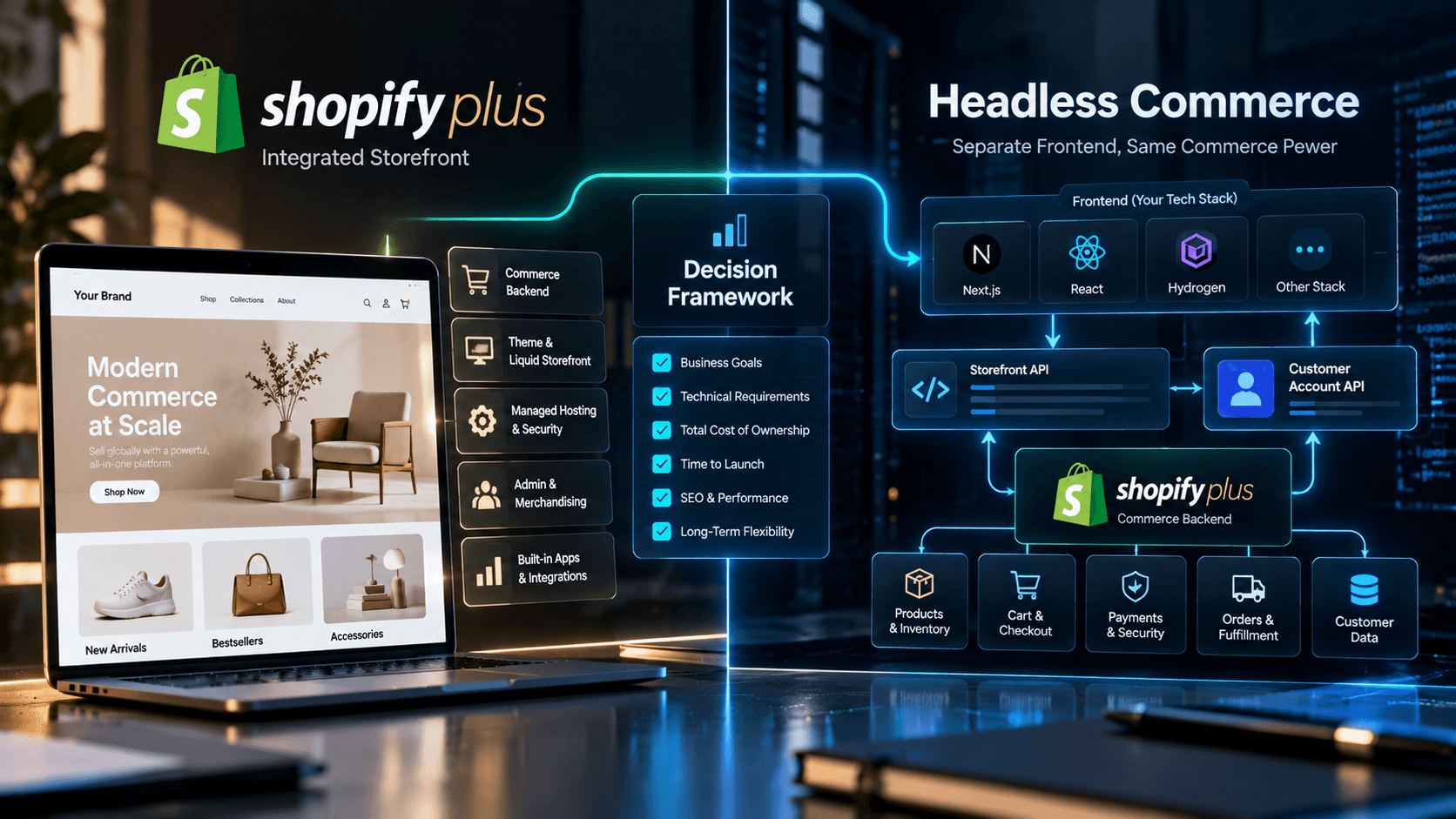
When enterprise e-commerce teams evaluate their storefront technology, discussions often frame Shopify Plus and headless commerce as mutually exclusive choices. Decision-makers frequently ask whether they should stay on standard Shopify Plus or "go headless" to gain greater design flexibility and improve performance. In reality, Shopify Plus is a managed commerce platform and enterprise plan tier, while headless commerce is an architectural design pattern that separates the customer-facing frontend from that backend. Shopify Plus natively supports both traditional integrated themes and decoupled headless storefronts. The real decision is not about choosing between two rival platforms; it is determining whether the commercial benefits of a custom frontend justify the ongoing engineering and operational responsibilities that headless architecture requires.
Shopify Plus and headless commerce are not opposites
What Shopify Plus Provides
Shopify Plus is Shopify's enterprise tier, offering a scalable, fully managed commerce engine. It handles product catalog databases, inventory tracking, customer accounts, and high-volume checkout processing. Plus accounts receive expanded API rate limits, dedicated enterprise B2B capabilities (such as negotiated price lists, payment terms, and draft order workflows), up to 9 expansion stores for international markets or sub-brands, unlimited staff accounts, and prioritized technical support.
According to Shopify's official Plus pricing documentation and Shopify Plus plan documentation, baseline platform pricing starts at $2,500 USD per month on a 1-year contract, or $2,300 USD per month on a 3-year term (subject to commercial negotiation, regional adjustments, and billing currency). For more complex, higher-volume businesses, Shopify applies a variable platform fee based on revenue and business model (with distinct structures for B2B and D2C brands), with exact commercial terms confirmed directly by Shopify. When using third-party payment gateways rather than Shopify Payments, an additional transaction fee (typically 0.20% per transaction on Plus where Shopify Payments is available) applies on top of the merchant's external processor rates. Payment processing rates and variable platform fee terms vary depending on geography, card types, currency, and negotiated merchant agreements.
What Headless Commerce Actually Means
Headless commerce decouples the presentation layer—the website or application storefront where customers browse products, view editorial content, and add items to a cart—from the commerce engine that manages inventory, pricing, customer data, and checkout. The frontend communicates with the backend exclusively through APIs.
Because headless is an architectural pattern rather than a proprietary vendor product, you can build a headless storefront powered by Shopify Plus just as easily as you could with other commerce backends.
Three Core Architectures to Compare
- Integrated Shopify Plus: Both the commerce engine and the customer storefront reside within Shopify, built using Shopify's Liquid theme engine, Section rendering, and native App Store extensions.
- Shopify Plus with a Headless Storefront: Shopify remains the underlying commerce engine (handling products, customer accounts, orders, and secure checkout), while an independent frontend—built with Shopify's Hydrogen library or an alternative framework like Next.js—consumes Shopify's APIs.
- Composable Enterprise Commerce: A modular architecture where multiple independent SaaS vendors (a decoupled commerce backend, a standalone headless CMS, dedicated enterprise search, and personalized merchandising tools) are connected via APIs rather than relying on a single platform ecosystem.
Each model represents a very different allocation of engineering responsibility, operational cost, and organizational control.
How Shopify Plus headless commerce works
In a headless Shopify implementation, the frontend application is completely decoupled from Shopify's theme layer, connecting to core commerce services through specialized APIs.
Storefront API: The Central Commerce Gateway
Shopify's Storefront API (GraphQL) is the primary bridge for any headless storefront. It allows custom frontends to query product catalogs, collections, customer accounts, and international market data, as well as create and manipulate shopping carts. When the customer is ready to complete their purchase, the custom frontend redirects the user to Shopify's secure, hosted checkout. The Storefront API is framework-agnostic, meaning it can power any modern web framework, mobile app, or connected device.
Customer Account API
The Customer Account API provides authenticated customer management, enabling headless storefronts to present order histories, saved shipping addresses, and profile settings directly within the custom frontend, or route users to Shopify-hosted customer account pages.
Hydrogen, React Router, and Next.js Implementation Paths
Shopify supports multiple paths for building headless storefronts, as detailed in Shopify's Hydrogen getting-started guide, the Hydrogen 2026-10 release notes, and the Storefront API documentation:
- Shopify Hydrogen 2026-10: With the general availability of Hydrogen 2026-10, Shopify transitioned Hydrogen from an opinionated framework previously bound to a React Router / Remix foundation into a framework-agnostic JavaScript library. The library supplies essential commerce primitives—including cart state management, variant selection, multi-currency pricing, customer accounts, and analytics—that developers can integrate into their framework of choice. Shopify provides official starter templates for both React Router and Next.js (such as Vercel Shop), and storefronts can be hosted on Oxygen (Shopify's edge worker hosting platform) or other hosting providers. Oxygen hosting is included across Shopify plans, but public environment limits differ by plan tier: Starter, Basic, Grow, and Advanced include 1 public environment, while Shopify Plus plans include up to 25 public environments per store for production, staging, and branch previews (as documented in Shopify's Oxygen environments guide), distinct from the number of separate storefronts or expansion stores operated.
- Next.js Storefronts: Teams with established Next.js expertise can adopt the official Next.js Hydrogen starter maintained in collaboration with Vercel or build bespoke App Router storefronts. Crucially, merchants are not required to adopt Hydrogen to use Next.js; teams can query Shopify's GraphQL Storefront API directly, leveraging React Server Components, Incremental Static Regeneration (ISR), and deployment across Vercel, AWS, or Cloudflare.
- Framework-Agnostic Freedom: Because Shopify's Storefront API is entirely framework-agnostic, engineering teams can build storefronts using Astro, Nuxt, SvelteKit, or native mobile SDKs—either by incorporating the Hydrogen library into their server stack or by connecting directly to the Storefront API via the Headless sales channel.
Shared Responsibility: What Shopify Manages vs. Merchant Obligations
In a headless implementation, Shopify continues to manage core backend systems: catalog databases, inventory tracking, order management, high-volume checkout processing, Level 1 PCI DSS compliance for the checkout, and payment processing.
However, headless architecture introduces a shared responsibility model. While Shopify secures the checkout and database, the merchant and their engineering team assume full operational responsibility for:
- The custom frontend application codebase, edge hosting uptime, and CDN routing.
- Security patching and dependency maintenance across NPM packages.
- Protecting API tokens and ensuring public credentials are restricted to read-only Storefront scopes.
- Managing customer session state, custom middleware, and third-party tracking scripts.
- Designing accessible, responsive UI/UX and optimizing frontend Core Web Vitals.
Where Shopify Plus wins
For the majority of ecommerce brands, an integrated Shopify Plus implementation using modern Liquid themes remains the most cost-effective and operationally sound choice.
Rapid Time to Market
Launching or redesigning an integrated Shopify Plus store typically takes weeks rather than months. Agencies and internal teams can leverage battle-tested theme foundations, pre-built responsive components, and visual section builders, dramatically reducing upfront engineering hours.
Marketing Team Autonomy
Marketers and merchandisers can independently create landing pages, adjust promotional banners, modify collection layouts, and launch seasonal campaigns through Shopify's visual theme customizer. They do not need to submit tickets to a development queue or wait for developer release cycles to update basic store content.
Plug-and-Play Ecosystem
The Shopify App Store contains thousands of apps for reviews, loyalty programs, email capture, and subscriptions. On an integrated theme, these tools install with minimal technical overhead via Theme App Extensions. In a headless environment, nearly every app feature requires custom API integration, custom UI components, or middleware development.
Managed Infrastructure and Reduced Operational Overhead
Shopify provides managed server capacity, global CDN distribution, edge caching, and platform security patching. This setup relieves merchants of managing cloud virtual machines, container orchestration, or manual server scaling during seasonal traffic surges. While no cloud provider or platform guarantees 100% uptime, Shopify's managed architecture significantly reduces infrastructure operational overhead compared to running self-hosted backends.
Where headless commerce wins
While integrated themes handle standard ecommerce well, certain enterprise business models run into hard platform constraints. Headless architecture is designed to solve those specific bottlenecks.
Bespoke User Experiences and Product Configurators
If your sales model relies on complex, interactive product customizers, 3D product previews, dynamic bundling logic, or visual storytelling that exceeds Liquid's template hierarchy, a headless frontend grants your engineering team greater control over the storefront interface and user experience.
Multi-Channel and Non-Browser Digital Touchpoints
If your business serves customers across native iOS and Android mobile apps, in-store interactive kiosks, smart mirrors, or voice interfaces, the Storefront API can support these connected channels from a single Shopify Plus catalog and inventory engine when the necessary custom integrations are implemented.
Advanced Content-Commerce Integration
Brands with heavy editorial publishing requirements often find Shopify's native blog and page builders limiting. Headless architecture allows teams to pair Shopify Plus with an enterprise headless CMS (such as Sanity, Contentful, or Strapi), giving editorial teams structured content modeling, localized publishing workflows, and granular approval controls.
Enterprise Development Velocity
For organizations with large engineering departments, decoupling the frontend allows web developers to work in modern frameworks (such as Next.js or React Router) using standard CI/CD pipelines, automated testing suites, and component design systems without being constrained by Shopify's theme structure.
The real cost comparison
The most common mistake when evaluating this architecture is comparing "Shopify Plus" against "a headless build" as though the platform subscription represented the entire cost of the integrated route and a one-time build fee represented the entire cost of headless. Both models involve ongoing subscription, infrastructure, and engineering commitments; headless simply adds distinct categories of ownership.
| Cost Category | Integrated Shopify Plus | Shopify Plus Headless Storefront |
|---|---|---|
| Platform Subscription | Starting at $2,500/mo (1-yr) or $2,300/mo (3-yr) USD baseline; variable platform fee applies for complex, higher-volume businesses based on revenue and model | Identical — the Shopify Plus subscription is unchanged by your frontend architecture choice |
| Payment Processing | Standard Shopify Payments rates; or processor fees plus ~0.20% additional transaction fee if using a 3rd-party gateway | Identical — checkout and payment processing remain on Shopify |
| Initial Storefront Build | Theme customization or bespoke Liquid development | Custom frontend engineering (Shopify Hydrogen or Next.js) requiring substantially more development hours |
| Storefront Hosting | Included in Shopify Plus infrastructure | Oxygen edge worker hosting (included across plans, with up to 25 public environments on Plus) or independent edge hosting (e.g., Vercel, AWS) |
| Content Management & CMS | Native Shopify admin and Theme Sections | Often paired with a dedicated headless CMS (Sanity, Contentful, Strapi) for advanced editorial control |
| Search & Discovery | Native Shopify Search & Discovery or App Store solutions | Often integrated with specialized enterprise search APIs (Algolia, Constructor) |
| Apps & Integrations | Standard plug-and-play Shopify App Store integrations | App functionality often requires custom API integration or headless middleware |
| Ongoing Maintenance | Theme updates and routine app compatibility checks | Active frontend codebase maintenance, NPM dependency updates, and Storefront API version migrations |
| Engineering Staffing | Primarily merchandising and marketing operations with light dev support | Sustained frontend software engineering team required long-term |
| Migration & SEO Preservation | Lower replatforming risk on the same core platform | Full URL mapping, 301 redirects, sitemap resubmission, and an initial 4–6 week Search Console monitoring window |
Illustrative Planning Range: As outlined in Belk Digital's Next.js and Headless CMS Enterprise Playbook, an enterprise headless commerce implementation typically ranges from $60,000 to $180,000+ over a 14–24 week development timeline for high-volume merchants with bespoke functional and checkout requirements. This figure represents an illustrative agency planning estimate for complex enterprise builds, not a universal industry standard or rigid quotation. Actual investment depends on catalog scale, checkout customization, integration complexity, and whether the build utilizes Shopify Hydrogen or an independent Next.js stack.
Total Cost of Ownership (TCO) Evaluation Framework
When modeling long-term budget, evaluate six distinct cost pillars: (1) core platform subscription and payment transaction fees, (2) initial design and frontend engineering, (3) third-party SaaS subscriptions (headless CMS, enterprise search, personalization), (4) edge hosting and infrastructure, (5) sustained developer staffing and dependency maintenance, and (6) migration execution and technical SEO preservation. A headless architecture expands categories 2 through 5; it does not replace or eliminate category 1.
Performance, SEO, and Core Web Vitals
Architectural Levers for Performance
A decoupled frontend grants engineering teams complete control over rendering strategies—enabling Static Site Generation (SSG) for high-traffic landing pages, Incremental Static Regeneration (ISR) for product catalogs, and edge caching for fast global responses. Teams can strictly audit and limit client-side JavaScript payloads, eliminating the script bloat often introduced by accumulated third-party Shopify apps.
The Operational Overhead of Headless Technical SEO
While headless architecture unlocks performance potential, it also shifts full technical SEO responsibility to your developers. Server-side rendering (SSR) for search crawlers, canonical URL generation, XML sitemaps, Open Graph metadata, structured data, and hreflang tags must all be engineered, tested, and maintained in the custom frontend rather than managed automatically by Shopify.
Validating Performance Prior to Commitment
Never assume that headless architecture automatically yields faster load times or higher search rankings. A poorly optimized headless site with bloated client-side hydration can easily underperform an optimized Shopify Plus theme. Prior to migrating, benchmark your current site's Core Web Vitals in Search Console, build functional prototypes under simulated real-world network conditions, and base your architectural decision on verified performance data.
Enterprise decision framework
Choose Integrated Shopify Plus When...
- Your business and UX requirements are fully satisfied within modern Shopify themes and Sections.
- You want to launch quickly with minimal upfront capital expenditure.
- Your operational model relies on marketers and merchandisers without dedicated frontend developers.
- You want Shopify to manage all frontend hosting, security, and platform updates.
Choose Shopify Plus with a Headless Storefront When...
- You have specific, articulated design or interactive requirements that Liquid cannot deliver.
- You operate multiple digital touchpoints (web, mobile apps, digital signage) from a unified catalog.
- Your brand demands deep integration with an enterprise headless CMS for rich editorial experiences.
- Your organization possesses (or has contracted) sustained engineering capacity to own and maintain a custom frontend codebase indefinitely.
Consider a Broader Composable Architecture When...
- Your enterprise requires specialized best-of-breed vendors for inventory, pricing, search, and checkout across complex global operations.
- You are prepared to manage multiple vendor contracts, service-level agreements, and complex multi-API integration middleware.
A 12-Question Pre-Migration Checklist
- What specific commercial or UX limitation in our current store cannot be resolved with an optimized theme?
- Can that bottleneck be solved within Shopify Plus's native theme and app ecosystem first?
- Do we have sustained, ongoing engineering resources to maintain a standalone frontend application?
- Have we modeled total cost across all six TCO categories, rather than relying solely on an initial build quote?
- Which frontend implementation path — Shopify Hydrogen (with its React Router or Next.js starters), a custom Next.js storefront, or an alternative framework — aligns with our engineering team's current capabilities?
- Does our content model require an external headless CMS, and what are its recurring subscription and operational costs?
- Who owns the complete URL inventory and 301 redirect mapping protocol?
- What is our current baseline for Core Web Vitals (LCP, INP, CLS) and organic search visibility in Google Search Console?
- Who is responsible for ongoing Storefront API version migrations and frontend dependency maintenance?
- What is our technical rollback protocol if the headless storefront underperforms post-launch?
- How many international markets, currencies, or expansion storefronts must this architecture support?
- What specific commercial KPIs define success at 90 days post-launch?
Fazit
Shopify Plus and headless commerce answer two fundamentally different questions: Shopify Plus provides the enterprise commerce engine, while headless commerce determines where and how the frontend is built. For many brands, a well-architected, properly optimized integrated Shopify Plus theme represents the most cost-effective and dependable solution. Headless architecture makes sense when complex customer journeys, multi-channel distribution, or rich editorial workflows justify the additional engineering overhead. Before committing to a migration, evaluate total cost of ownership across infrastructure and ongoing staffing, review the 12-question checklist, and confirm your team has the sustained resources to maintain a bespoke web application. For an objective architectural evaluation tailored to your catalog and business goals, explore Belk Digital's eCommerce Development services.
Primary Documentation & Authoritative Resources
- Shopify Help Center: Shopify Plus Plan and Features — Official overview of Plus enterprise capabilities, expansion stores, and limits.
- Shopify Plus: Official Enterprise Pricing Overview — Official commercial terms, base licensing, and transaction fee guidelines.
- Shopify.dev: Hydrogen Getting Started Guide — Official guide to the framework-agnostic Hydrogen library and starter templates.
- Shopify.dev: Hydrogen 2026-10 Announcement — Changelog detailing Hydrogen's framework-agnostic architecture and React Router and Next.js starters.
- Shopify.dev: Storefront API Getting Started — Technical guide for querying Shopify's GraphQL Storefront API.
- Shopify.dev: Deploy to Oxygen Guide — Documentation on deploying Hydrogen storefronts to Oxygen edge worker hosting.
- Shopify.dev: Oxygen Environments Documentation — Official guide to Oxygen environment limits (up to 25 public environments on Shopify Plus, 1 on lower plans) and branch previews.
Häufig gestellte Fragen
Benötigen Sie Expertenhilfe dabei?
Wenn Sie diese Strategien für Ihr Unternehmen umsetzen möchten, kann unser Team Ihnen helfen, mit Zuversicht zu planen, zu bauen und zu skalieren.
KontaktBereit, Ihr Projekt zu starten?
Let's discuss how we can help you achieve your digital goals and create an exceptional online presence.